The closing shift: the 15 minutes at the end of the day that decide your morning
A good morning is mostly manufactured the night before. Here is the research on why an unclosed day taxes both your evening and your next morning, the four jobs an end-of-day routine has to do, and a named 15-minute closing shift you can run in any calendar or notes app.
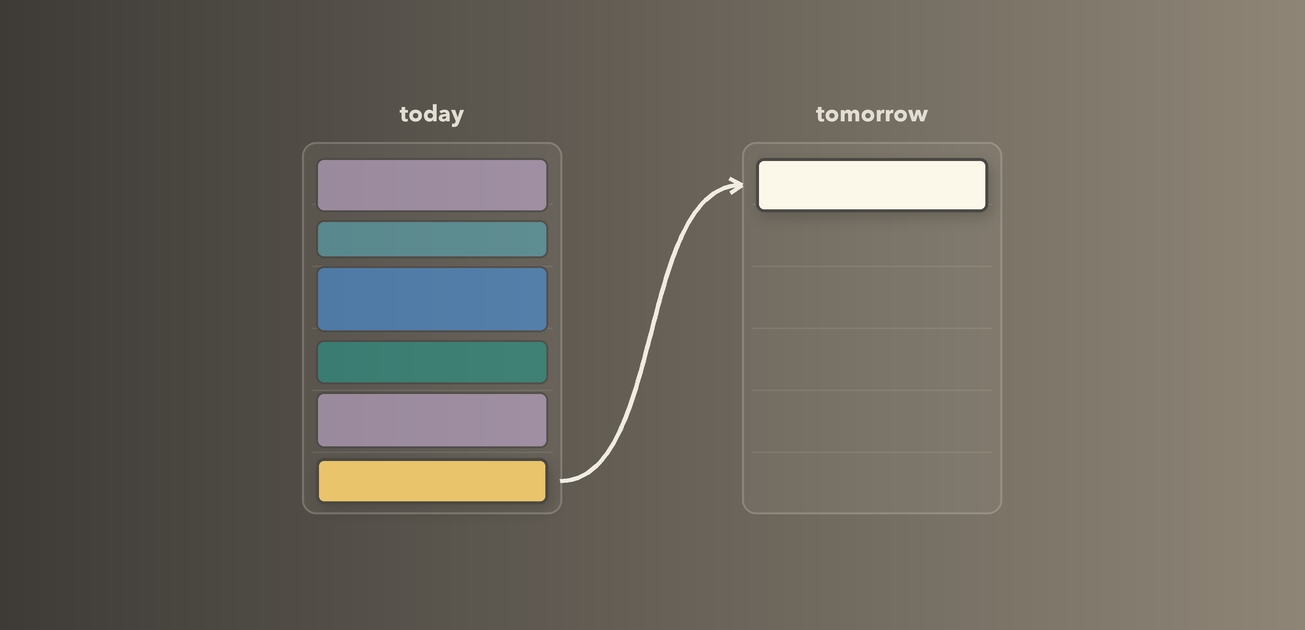
It is 9:04 on a Tuesday. You open the laptop. There are 47 unread emails, a Slack thread that ended at 5:41 last night with someone saying "sounds good, can you send it over?", and a browser tab titled "Pricing v3 DRAFT" that you do not remember opening.
You start reconstructing. What was I doing at the end of yesterday. Which of these threads is urgent. There was something I promised Dana: the revised numbers, or the deck? Thursday, or today? You open the doc, read four paragraphs of your own writing, and cannot tell whether section 3 is finished or abandoned.
At 9:29 you have read everything and decided nothing. So you keep picking at the inbox, because picking at the inbox does not require a decision. The first real work of the day starts around 9:45, in a 40-minute gap before your first meeting.
Those 41 minutes were not a focus problem or a willpower problem. They were a handoff problem. Nobody closed yesterday, so today had to reopen it from scratch.
Most knowledge workers have no closing shift
In a restaurant, the last fifteen minutes of service are not the end of today. They are the beginning of tomorrow. Someone breaks down the line, restocks the low bins, preps the mise for the morning crew, and writes on the board what the opener needs to know. The shift does not end when the work runs out. It ends when the next shift has been set up.
Almost no knowledge worker does this. The day does not close, it just stops, usually mid-thought, when a meeting runs late or the laptop lid comes down because dinner is happening. Whatever was in your head at 5:41 is still there at 9:04 the next morning, except degraded, because you spent fifteen hours not writing any of it down.
The routine that is missing is the closing shift. It is the most underbuilt fifteen minutes in a knowledge worker's day, and it is where most of the value people credit to their morning routine actually gets created.
Why the unclosed day follows you home
Two mechanisms are at work, and they produce two different symptoms: why you cannot put the day down at night, and why the next morning is so expensive.
The first is unfinished business intruding on everything else: one open loop is fine when you are back in ten minutes, and eleven of them are corrosive when you are trying to eat dinner. The familiar name for this is the Zeigarnik effect, after Bluma Zeigarnik's 1927 report that people recalled interrupted tasks better than completed ones. Use the name and not the study. The original memory result has aged badly, and Colin MacLeod's 2020 review of the literature found that fewer than a third of the replication attempts reproduced it, with one careful replication coming out backwards.
The study this post actually rests on came later. In 2011, E.J. Masicampo and Roy Baumeister published "Consider it done! Plan making can eliminate the cognitive effects of unfulfilled goals" in the Journal of Personality and Social Psychology. Across five studies, people carrying an unfinished goal paid for it somewhere unrelated: more intrusive thoughts and worse comprehension while reading a passage that had nothing to do with the goal, and worse performance on an unrelated anagram task. The studies also ran a plan condition, in which participants wrote out in detail how, when, and where they would complete the task. The interference did not show up in that group.
Read that precisely, because it is the basis of this post. The task was still unfinished. Nothing got completed. What released the cognitive load was writing a specific plan. And in the fourth study the benefit tracked how earnestly the plan was made: the people who went on to actually carry theirs out were the ones who stopped paying the cost. Your brain will let something else hold the loop, but it does not seem to accept a plan you have no intention of keeping.
The second mechanism is attention residue, which Sophie Leroy documented in a 2009 study of task switching. When you move between tasks, part of your attention can stay stuck on the first and degrade your performance on the second, and it sticks hardest when the first task was left unresolved. Leroy's later work with Theresa Glomb, published in Organization Science in 2018, found the lever. What generates the residue is anticipating that you will have to resume the interrupted task under time pressure, and a brief "ready to resume" plan, written before you switch away, measurably reduces it.
Together they explain the geometry of an unclosed day. Ending mid-loop is an interruption, not a completion, so the residue follows you into the evening. That is why you are still half-composing an email at 8pm. And because the loop was never written down, the next morning has to reconstruct it from artifacts. That is the 41 minutes.
An unclosed day is charged twice. Once tonight, once tomorrow.
The four jobs a closing shift has to do
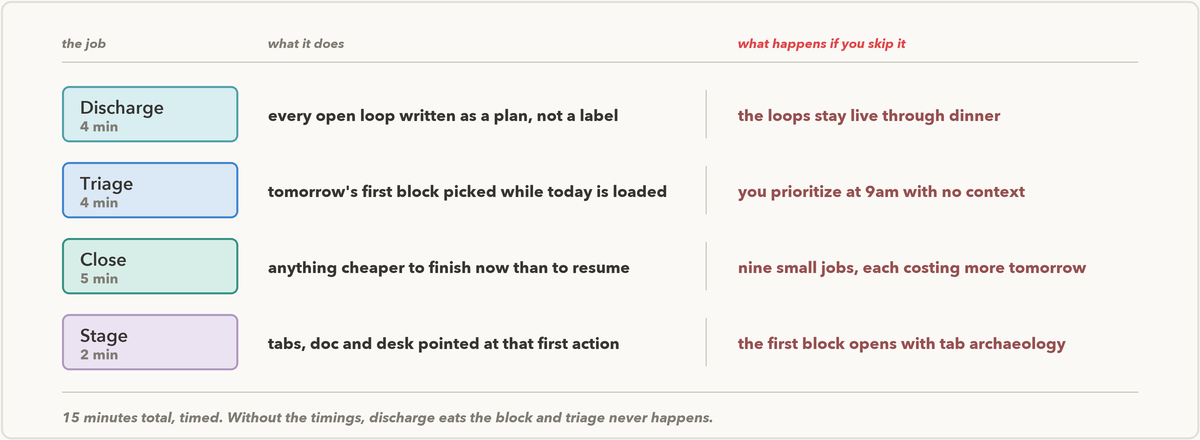
A closing routine that only lists what you did today is a diary, and diaries do not reduce residue. Four distinct jobs have to happen, and each one fails in its own way when you skip it.
Discharge. Get every open loop out of your head and into writing, as a plan rather than a list. This is the Masicampo and Baumeister step done literally. Not "follow up with Dana," which is a label, but "Wednesday, in the 11:00 block, send Dana the revised volume-discount numbers." A loop written as an intention with a time attached stops being carried. Two words on a list is still being carried, which is why long unstructured to-do lists often feel worse than no list.
Triage. Decide what tomorrow's first block actually is, tonight, while the context of today is still loaded. This is the highest-value item in the protocol and the most commonly skipped. The version of you that closes today knows why the pricing doc matters, which section is broken, and what Dana asked for. The version that opens tomorrow knows none of that, is not caffeinated, and is being asked to prioritize while looking at 47 unread emails. Do not delegate a judgment call to the least-informed version of yourself.
Close. Finish the small things that cost more to resume than to complete: the two-minute rule applied at the end of the day rather than the beginning. A three-line reply, an invite you said you would send, a comment on a PR, renaming a file so tomorrow's you can find it. A ninety-second job tonight is almost never a ninety-second job tomorrow, because tomorrow has to reload the whole context before it can spend the ninety seconds.
Stage. Leave the physical and digital environment set up for the first task. Close the eleven tabs that belong to today, leave open exactly the ones that belong to tomorrow's first block, clear the desk to the one thing you will pick up first. Staging converts a decision into an action: tomorrow you do not have to start the task, you have to continue one that is already visibly in progress. Skip it and the defended first block opens with fifteen minutes of tab archaeology.
The protocol: a 15-minute closing shift
Fifteen minutes, four timed segments, run at the end of the work day rather than at the end of your energy. Put it on the calendar as a real event, with an end time, on the days you actually work. The durations matter more than they look; without them, discharge expands to fill the block and triage never happens.
1. Discharge (4 minutes). Open your daily or weekly note. Write every open loop currently in your head as a plan, not a label. Format: what, when, where. "Thursday morning: draft the migration rollback section in the runbook doc." "Tomorrow 2pm block: reply to the three comments on the vendor contract." Four minutes covers six to ten items, and if it does not, that is itself the finding. This is where a weekly note earns its keep: the loops accumulate on one surface instead of scattering into five daily files.
2. Triage (4 minutes). Open tomorrow and look at the actual shape of the day: where the meetings are, where the real blocks are, which one is your best. Choose the single task that owns your first block and write it as a physical first action.
This is the load-bearing rule of the protocol. Tomorrow's first task has to be written as an action you could begin without making a decision. "Work on pricing" is a category. "Open pricing-v3.md and rewrite section 3, the volume-discount table" is an instruction. The first requires you to re-derive at 9am what you already knew at 5:40pm. The second you can execute while still holding coffee. Then write a one-line second choice underneath, your fallback if the first block gets eaten.
3. Close (5 minutes). Set a timer and clear every open loop that will take under two minutes. Send the three-line reply. Accept the invite. Push the branch. Rename Untitled-4.md to something you will recognize. When the timer ends, stop, even if two are left. Anything that survives goes back into discharge as a plan.
4. Stage (2 minutes). Close everything that belongs to today. Open the one document tomorrow's first action needs and leave the cursor in section 3. Clear the desk to the one thing you will pick up. Then stop working. The stopping is part of the protocol: a closing shift that bleeds into another 40 minutes of email has undone its own purpose.
A worked example
A real Wednesday. The last meeting ends at 4:45 and the closing shift runs 5:00 to 5:15. Discharge produces seven items, including "Thursday 11:00 block: send Dana the revised volume-discount numbers, from the pricing model tab and not the deck." Triage finds a 9:00 to 10:30 window before Thursday's first meeting and writes: "First block: open pricing-v3.md, rewrite section 3 using the model tab numbers. Fallback: review the migration PR." Close clears two replies, one invite, one file rename. Stage shuts fourteen tabs and leaves pricing-v3.md open at section 3.
Thursday at 9:02, the laptop opens on section 3 with an instruction attached. Real work starts at 9:03 instead of 9:45. Those 42 minutes were not saved by working harder in the morning. They were bought the night before, at a cost of fifteen minutes that were going to be spent half-reading Slack anyway.
This is the other half of the morning routine
We published a morning routine template that walks through reviewing your schedule, setting an intention, preparing for your first meetings, and protecting deep work. Every step of it is correct, and every step is dramatically cheaper if the closing shift ran the night before.
"Set your daily intention" is a five-minute research project at 9am and a thirty-second confirmation if triage already happened. "Set up your workspace" is tab archaeology in the morning and a non-event if staging already happened. "Review your weekly note" is hard when the last thing you wrote about the week was Monday, and trivial when yesterday's discharge is sitting at the top of it.
The morning routine is not wrong. It is downstream. If you only have fifteen minutes of routine discipline available, spend them in the evening. A morning routine with no closing shift does archaeology. A closing shift with no morning routine still works.
Frequently asked questions
My day never ends cleanly. I work until I collapse. Then the closing shift is not fifteen minutes you find at the end. It is fifteen minutes you schedule as an event, and it defines the end rather than following it. Your day has no clean end because nothing on the calendar marks one, so the work expands into the boundary. Before you decide you cannot spare the time, look at what the last 45 minutes of one of those days actually contained. Every time I have asked someone to do this, the answer has been residue work: half-attention email and Slack, done at the worst hour of their cognitive day. Trading that for fifteen structured minutes and an actual stop is close to free.
What if tomorrow's priority changes overnight? It sometimes does. It rarely changes completely. Amending a plan at 9am costs sixty seconds; no plan costs the full reconstruction pass plus a decision made with worse information. The comparison is not "correct plan versus wrong plan," it is "wrong plan versus no plan," and the wrong plan still wins because it gives the morning something to react against. And discharge keeps its full value regardless. Those loops did not stop existing because something urgent landed.
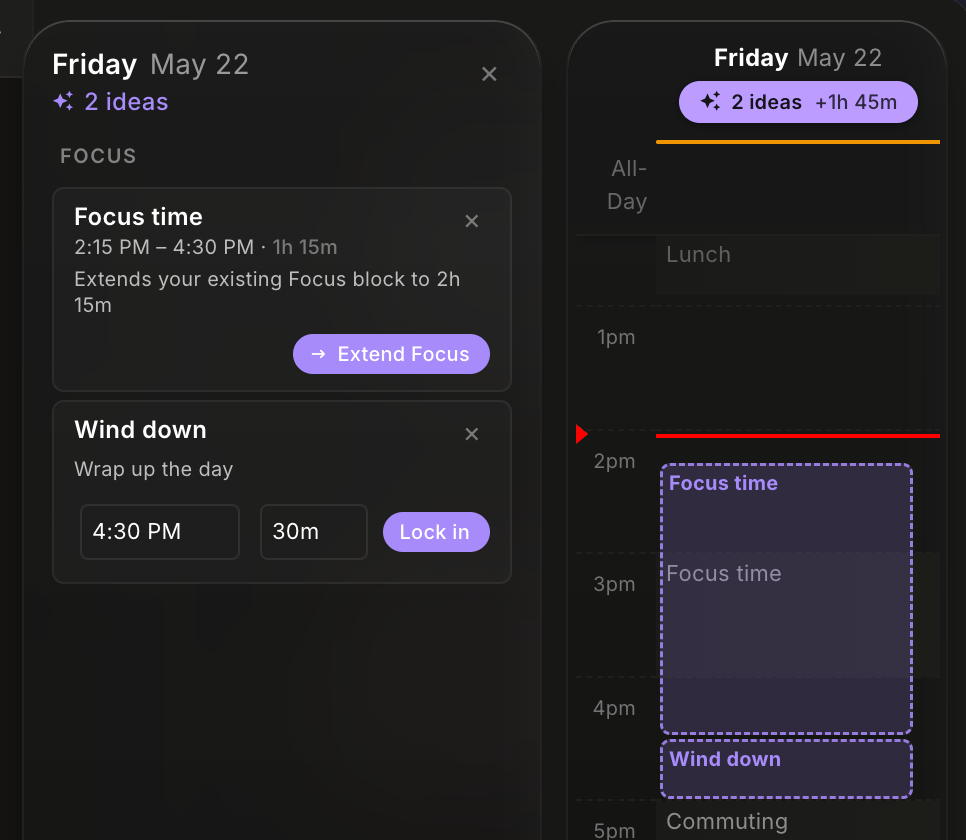
Does this work if I have back-to-back meetings until 6? Yes, with two modifications. First, the closing shift has to be a calendar block you own, which usually means booking 5:45 to 6:00 as a recurring event so it cannot be filled. Second, triage becomes more important, not less: if tomorrow is also back to back, your one real block is the only place work happens, and choosing what goes in it is the highest-leverage decision of the day. If you cannot get fifteen minutes, run a five-minute version with triage and stage only.
Should I review what I accomplished today as part of this? Only if it feeds a decision. Daily retrospective review feels productive and mostly is not. The one question worth asking is whether today's first block happened as planned. Track that for two weeks. If it is under half, the problem is upstream in your calendar's shape rather than in your evening routine, and the fix is a defrag pass on your fragmented time.
Closing thought
The version of you that ends the day knows more about your work than any other version of you will all week, and that knowledge has a half-life measured in hours. Fifteen minutes of writing it down is not a productivity habit. It is a handoff to a colleague who shows up tomorrow with none of your context and all of your responsibilities.
Try it for one week in whatever you already use: a notes app, a text file, the back of an envelope. The mechanics only require that you can write a sentence and see tomorrow's calendar at the same time. If those two happen to live on the same surface, tomorrow's first action attaches directly to the block that will execute it, which closes the last place a good plan goes missing: the gap between the note holding the decision and the calendar holding the time.
If you run this in nocal, the triage step is the one that changes shape. Peek at tomorrow without leaving today, write the first action into the note attached to that block, and it is waiting on the event when the block opens.
 Download for Mac
 Download for Windows
 Google Play Store