Time Confetti: Why a Half-Empty Calendar Can Feel Worse Than a Booked One
Your calendar shows four hours of open time, and you still ship nothing. Time confetti is the research-backed reason fragmented schedules feel busier than booked ones, plus a 5-minute daily defrag protocol for calendar management and deep work.
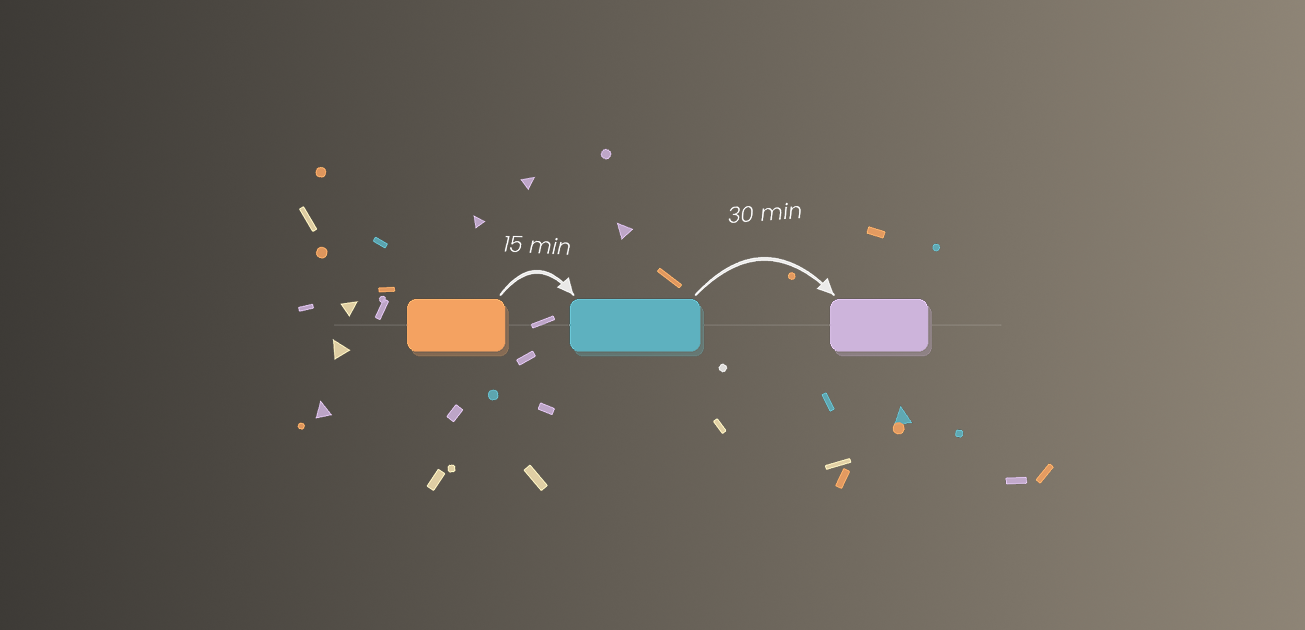
You looked at this morning's calendar and counted four hours that were not in meetings. By the time you closed your laptop, the deep work you planned to do in those four hours had not happened. The calendar was technically open. The day was not.
This is not a willpower failure. It is a structural one. The free time on your calendar was not free time at all. It was confetti.
What time confetti actually is
The term comes from journalist Brigid Schulte, who coined it in her 2014 book Overwhelmed. The pattern it names is specific: free time arriving in fragments too small to use. Fifteen minutes between two meetings. Twenty-five minutes before a 1:1. Forty minutes after lunch and before a review. The total adds up. The pieces do not.
Research on interruptions and attention describes the mechanics. Sophie Leroy's work on "attention residue" found that switching tasks can leave part of your attention stuck on the one you just left, and that the residue is worst when you leave a task unfinished, with no sense of closure. Gloria Mark and her colleagues at UC Irvine shadowed 24 information workers and tracked something related: how long it took people to get back to work they had been pulled away from. When interrupted work was picked up again the same day, about 25 minutes had passed, and people had worked on roughly two other things in between. That is elapsed time rather than a cognitive recovery penalty, but it describes the shape of a fragmented day precisely. If your free intervals are shorter than the time it takes you to get back into the work, you never reach the work itself.
A schedule made of confetti behaves the same way as a schedule with no free time at all. It is just harder to see, because the calendar grid keeps reporting capacity that the day never delivers.
The two failure modes of fragmented calendars
Fragmented schedules fail in two distinct ways, and the fix depends on which one is dominant in your week.
Switching tax. Every transition between blocks costs cognitive setup: opening the right tabs, recalling where you left off, muting notifications, finding the doc, getting back into the problem. If your gaps are 20 to 40 minutes long, the tax can consume more time than the gap itself. You do shallow work, or no work, and the time is gone.
Anticipatory drag. A meeting in 25 minutes does not feel like 25 minutes. It feels like "soon." You under-commit to the gap because you know you will be interrupted. This is sometimes called waiting mode, and it is why the half hour before a presentation rarely produces useful output even when nothing is technically blocking you.
Both failure modes compound when the gap-meeting-gap pattern repeats across a day. The total free time looks generous on the calendar grid. The usable time is close to zero.
Why "find time" is the wrong frame
The reflex when a week feels broken is to look for more time. Add focus blocks. Decline more meetings. Shift the standup. These tactics work, but they treat the problem as scarcity. The real problem is shape.
A calendar with two 90-minute focus blocks and six hours of meetings is more productive than a calendar with five hours of meetings and three hours of confetti. The first calendar contains less free time on paper. It contains far more usable time in practice.
Once you see this, the planning question changes. You stop asking "where can I add a focus block?" and start asking "where am I creating gaps that are too small to use?" Most of those gaps are self-inflicted. They come from accepting back-to-back meetings with 15 minutes between them, scheduling 1:1s in the middle of your best deep-work hours, and treating "between meetings" as time the calendar found for you rather than time you have to design.
A daily defrag protocol
Weekly planning is useful, but most calendars do not stay weekly. By Tuesday, two new meetings have landed on Wednesday, a 1:1 has moved into your maker time, and the focus block you defended on Sunday has been quietly cut in half. Defragmenting once a week assumes a stable artifact. The calendar is not stable.
A daily defrag is the smaller, more honest version. It takes about five minutes, runs either at the end of the previous day or the first thing in the morning, and treats today as the unit of work that actually exists. The goal is not to eliminate fragmentation, which is impossible in any meeting-heavy job. The goal is to make sure that when fragmentation happens today, it is intentional.
1. Audit today's gaps, not today's meetings. Open today and look only at the white space. For each gap under 45 minutes, ask one question: is there a meeting on either side that could still move so this gap merges with another? Most days have at least one such candidate. A 25-minute gap and a 40-minute gap in the same morning, separated by a meeting that could happen in the afternoon, will combine into a 90-minute focus block if you move one event. That single change is worth more than declining a meeting outright. Send the move request now, while the day is still flexible.
2. Pre-decide what each block is for. A focus block without a designated task is a gap with a longer name. Before the day starts, write the specific task next to each block: "draft the Q3 review," "review the security doc," "outline the migration plan." Two minutes of pre-decision saves the 15 to 20 minutes of starting cost when the block arrives. This is also where notes and calendar should not be separate systems. The block is the entry point. The notes are the work itself. If they live in different tools, you pay the switching tax twice.
3. Protect the first 30 minutes after a meeting ends, not the meeting itself. This is the counterintuitive part. The cost of a meeting is rarely the meeting. It is the residue. If a 30-minute meeting ends at 11:00, do not schedule another meeting at 11:00. The meeting that runs five minutes long, or the followup that lands in your inbox, will eat the next half hour anyway. A 30-minute buffer after every meeting often produces more usable time than a 60-minute focus block scheduled three meetings later.
A worked example
Take a Tuesday morning that starts looking like this: a 9:00 standup ending at 9:15, a 9:45 product sync ending at 10:30, an 11:00 vendor call ending at 11:30, and lunch at 12:30. On the calendar grid, that morning shows roughly 75 minutes of free time across three gaps: 30 minutes, 30 minutes, and a 60-minute slot before lunch.
In practice, that morning produces almost no deep work. The first two gaps disappear into recovery and prep. The third has anticipatory drag against lunch, so it gets used for inbox triage instead.
A 90-second defrag, run that morning, changes the shape. Move the vendor call to 2:00 the same afternoon. The morning collapses into one continuous block from 10:30 to 12:30. Pre-decide its task: "first draft of the migration plan." Add a 15-minute buffer after the standup so prep for the product sync does not bleed back into recovery time. The total free time on the calendar is unchanged. The usable time roughly triples, because shape was the constraint, not capacity.
Where the weekly view still helps
A daily protocol does not replace weekly thinking; it replaces weekly planning. Use Friday or Sunday for the second-order questions only: which recurring meetings are creating most of the confetti, which days of the week are structurally worse than others, and which commitments need to be renegotiated rather than rearranged. Tactics live in the daily pass. Strategy lives in the weekly one.
What to measure
The honest test of a defragmented week is not how full your calendar looks. It is whether the work you intended to ship actually shipped. Two simple measurements are enough.
How many of the focus blocks you scheduled produced output you would have made progress on regardless? If the answer is fewer than half, the blocks are too small or too poorly defended.
How many meetings ended at the time they were scheduled to end? If the answer is fewer than 60 percent, the buffers between them are not buffers. They are part of the meeting.
Track these for two weeks. The pattern is usually clear by the end of the first one.
Frequently asked questions
How is time confetti different from regular context switching? Context switching describes the cognitive cost of moving between tasks. Time confetti describes a specific calendar shape that forces context switching even when you are trying to focus: free time arriving in fragments smaller than your recovery window. Confetti is the structural cause; switching cost is what you feel.
What is the minimum useful focus block? For most knowledge work, 60 minutes is the practical floor and 90 minutes is the comfortable one. Below 45 minutes, the setup and recovery costs eat enough of the block that you are doing shallow work even if you do not notice. Treat anything shorter than 45 minutes as administrative time, not focus time, and plan accordingly.
Should I just refuse all meetings under 30 minutes apart? No. The goal is shape, not scarcity. A morning with three back-to-back meetings followed by a clean two-hour block is more productive than a morning with the same meetings spaced "politely" 25 minutes apart. Cluster the meetings, then defend the contiguous block on the other side of the cluster.
Where do notes fit into this? Notes are the part of the work the calendar does not contain. If your block says "draft the migration plan" and the actual draft lives in a separate tool, the first ten minutes of the block go to finding it. Keeping the note attached to the block, in the same tool or at least one click away, removes one of the most common sources of switching tax inside what should already be a defended hour.
Is this just time blocking with extra steps? Time blocking decides what each block contains. Defragmenting decides what shape the blocks make. Both work better together. Most people who say time blocking failed for them blocked the right tasks but never fixed the underlying shape, so the blocks kept getting cut into confetti.
Closing thought
A calendar is the most accurate map of your attention you will ever have. A fragmented calendar is not a sign that you are busy. It is a sign that something else is doing your planning for you: the scheduler that auto-suggests slots, the colleague who books across your maker time, the recurring meeting nobody has questioned in eight months.
Defragmenting is not about discipline. It is about taking the pen back. Spend five minutes each morning with today open, and ask the question most calendars never get asked: where is this shape coming from, and is it the shape I want?
If you want to test the protocol, do it inside whatever calendar app you already use. The mechanics work anywhere you can move a block and write a sentence next to it. If your tool also lets the notes for a block live where the block does, fewer of those blocks will turn into confetti.
Note: auto-defrag is coming soon to nocal. It will handle steps one and three of this protocol automatically: flagging gaps small enough to be confetti, suggesting which event to move so adjacent gaps merge, and reserving recovery buffers after meetings. Pre-deciding what each block is for still belongs to you.
 Download for Mac
 Download for Windows
 Google Play Store