How to plan a quarter in 90 minutes: pick one big rock and put it on the calendar
The quarter is the only planning horizon long enough to finish something real and short enough to still see the end. Here is why weekly and annual planning both fail as the primary unit, how to compute your actual discretionary capacity, and a 90-minute protocol that ends with blocks on a real calendar.
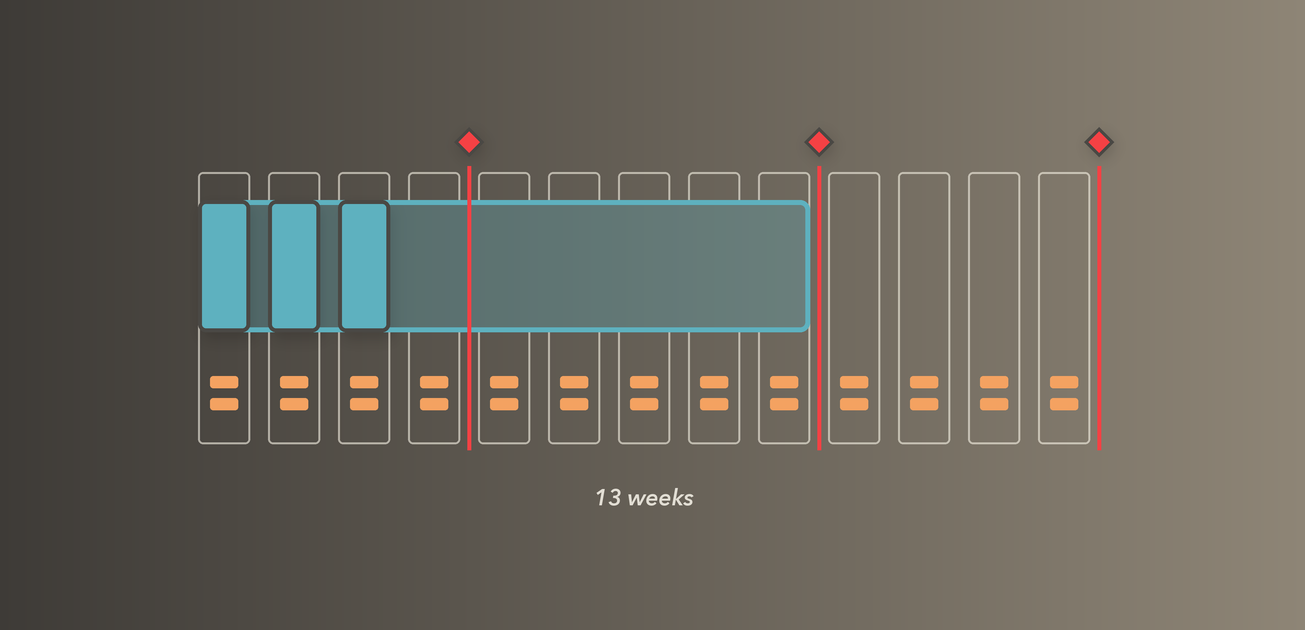
It is the last Friday of the quarter. Someone in a review asks what you shipped since July. You open your calendar and scroll back through thirteen weeks looking for the answer.
Every week is full. Monday standups, Wednesday product reviews, Thursday 1:1s. A two-day offsite in August, four all-hands, an interview loop that ran six weeks, a migration you unblocked twice. You did not have a slow day.
You cannot name the thing you finished.
This is the unnameable quarter, and it is not a discipline problem. You probably planned every week carefully, and may well have written annual goals in January. Neither artifact could produce a finished thing, because the week is too short to hold one and the year is too long to schedule one.
Why the week fails and the year fails
Weekly planning has a structural bias: it can only hold work that fits inside a week.
Sit down on Sunday with a blank week and the honest question is "what can I get done in the next five days?" Every answer that survives is small. Review the doc. Ship the fix. Run the interviews. Prepare the deck. Real tasks, almost all of them maintenance.
The rewrite that takes seven weeks never makes that list. On any given Sunday it is not something you can finish, only something you can make partial progress on, and partial progress competes badly against work that will be visibly done by Friday. So weekly planning quietly optimizes for closure, and thirteen well-planned weeks can produce thirteen tidy weeks and nothing you can name. A weekly plan built on the right four elements is the correct execution layer, and the wrong place to decide what the quarter is about.
The year fails in the opposite direction. An annual goal carries no scheduling pressure, because the deadline is too far away to price. In March, "learn systems design properly" costs nothing to postpone. In June it still costs nothing. The first month it exerts real force is Q4, when nine weeks remain and the goal converts into a heroic sprint or a line item that rolls into January. This is why preparing for a new year in December rather than on January 1st beats resolutions: it moves the planning closer to the execution.
Thirteen weeks is long enough to finish a rewrite, a certification, or a hiring round, and short enough that on day one you can see the last day. That visibility produces scheduling pressure.
Compute your real capacity, not your nominal one
Start with 13 weeks and subtract the ones that are structurally not yours: holidays, the company shutdown, planned vacation, the offsite, the two weeks around a launch when nothing else will happen. For most people planning the next quarter, that removes one to three weeks before anything else is counted.
Then go inside the week. Add up the hours in a typical week already spoken for: recurring meetings, 1:1s, standups, on-call, the interview loop you are on. Add a realistic figure for prep and recovery, which is real cost even though it never gets booked; the shadow calendar walks through that measurement. What remains is your discretionary capacity; multiply it by your usable weeks.
A senior engineer plans her next quarter with 13 weeks, minus a holiday week and a vacation week, leaving 11. Her week has 40 nominal hours, of which 14 are recurring meetings and 7 are prep, recovery, and inbox. That leaves 19 hours genuinely hers: 209 for the whole quarter. She had been planning against something much closer to 13 times 40, and that gap is where unnameable quarters come from.
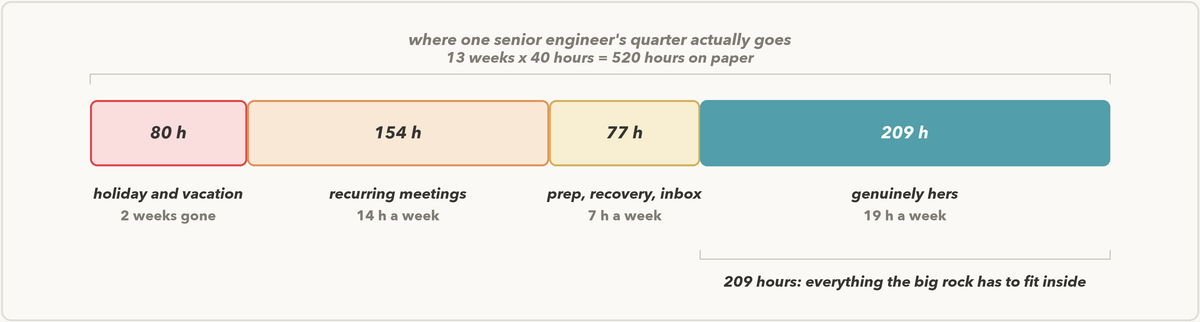
Compute your own number, once, in writing, rather than borrowing hers or a generic percentage from anywhere else. Kahneman and Tversky named the reason the result will feel too low: the planning fallacy, our tendency to underestimate how long work will take even when we know the last three things like it ran over. Quarters get planned the same way, against the version where nothing else lands on you.
The four kinds of work competing for your quarter
Commitments. Already promised to someone counting on them: the compliance deadline, the customer migration, the conference talk you accepted. Non-negotiable within the quarter, so they come out of capacity first, not last. If they alone consume most of your discretionary hours, renegotiate one now rather than discover the collision in week nine.
The big rock. The one outcome that makes the quarter worth remembering. Usually exactly one, at most two, and two only if the second is genuinely small. It is what you want to name on that last Friday, and the only item that will not happen by default.
Maintenance. The recurring load that happens whether you plan it or not: reviews, 1:1s, triage, support. It does not need planning, because it is self-enforcing. It needs measuring, so it stops silently expanding into the space the big rock needs. This is what a quarterly recurring-meeting audit attacks.
Optional. The side project, the tool migration nobody asked for, the refactor you keep almost starting. Optional work is not bad work. It is where your remaining capacity currently goes, which makes it the only place you will find hours for the big rock. Much of the plan is moving items from optional to not-this-quarter, in writing, so they stop drawing attention.
Run the four categories against the engineer above and the arithmetic gets blunt fast. Her commitments, a compliance evidence round in month one and a conference talk in month three, come to about 70 hours. That leaves roughly 140 of her 209 for the big rock: 13 hours a week across eleven weeks. Every optional item is bidding against that 13, and most of them have been winning without anyone deciding they should.
State outcomes, not activities
The highest-leverage discipline here is grammatical: write each item as a finished state, not an ongoing action.
"Work on the onboarding rewrite" is an activity. "Ship the onboarding rewrite to all new accounts" is an outcome. "Improve our test coverage" is an activity. "Get the payments service to 80 percent line coverage with CI enforcement on" is an outcome.
An activity is satisfied by any amount of effort, so it can never fail and can never finish. You can work on onboarding honestly and hard for thirteen weeks and reach the last Friday with nothing to name. An outcome has a binary end state, which is uncomfortable in exactly the way that makes it useful: it forces decomposition, and it makes slippage visible in week four rather than week twelve. Locke and Latham's goal-setting research found the same repeatedly: specific, difficult goals outperform vague "do your best" intentions. The test is whether a colleague who does not work with you could read your sentence in week 13 and say yes or no.
The 90-minute quarter plan
Block 90 uninterrupted minutes two weeks before the quarter starts, not on day one: you need the lead time to renegotiate commitments and claim calendar space before other people fill it. Set a timer for each segment and move on when it rings. The plan improves more from finishing all five than from perfecting one.
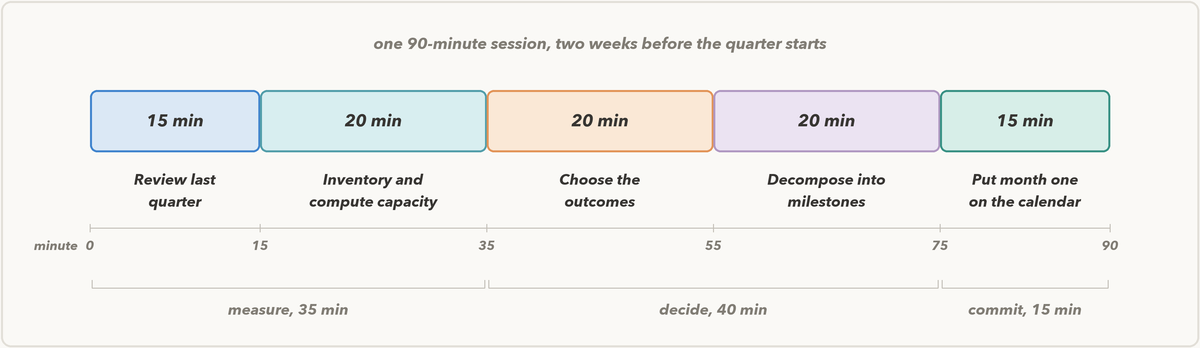
1. Review the quarter that just ended (15 minutes). Scroll your calendar forward week by week from the start of the ending quarter. Do not work from memory; memory reconstructs the quarter you meant to have. Write three lists: what shipped, what consumed more time than expected, and what you planned last quarter that never started. The third matters most. Items on it two quarters running are wishes, not goals. Delete them, or make one the big rock.
2. Inventory commitments and compute capacity (20 minutes). List every commitment with a date attached. Run the arithmetic above and write both numbers at the top of the file: usable weeks, and discretionary hours per week. Then subtract the hours your commitments will consume. What remains is the space the big rock has to fit inside. If it is negative, stop planning and go renegotiate a commitment. That conversation is the most valuable thing in this 90 minutes.
3. Choose the outcomes (20 minutes). One big rock, written as an outcome that passes the colleague test. Then name the two or three optional items you are explicitly not doing this quarter, with a note about when they might return. An unnamed optional project draws attention all quarter, because you never decided against it. It just loses, quietly, every week.
4. Decompose into monthly milestones (20 minutes). Three milestones, one per month, each a finished state. For "ship the onboarding rewrite to all new accounts": month one, new flow behind a flag in staging; month two, 10 percent of new accounts with instrumentation; month three, 100 percent with the old path deleted. If you cannot write a month-one milestone that is genuinely done by the end of month one, the big rock is too vague. Go back to segment three.
5. Put month one on the actual calendar (15 minutes). The segment everyone skips, and the one that makes the difference. Create real blocks for the next four weeks against the month-one milestone. Not a placeholder, not a reminder: events with the milestone in the title, in your best hours rather than the leftovers. Two 90-minute blocks a week is a reasonable starting shape. Book month one only; blocks further out get moved by other people while you are not looking.
A quarter plan that never touches the calendar is a wish list. Until the blocks exist, the big rock has no claim on any hour of the next thirteen weeks, and every meeting request gets weighed against a calendar showing the time as free.
The mid-quarter checkpoint
Put a 20-minute event at the halfway point during segment five: week six or seven. It has exactly one question, and it is not "how am I doing." It is: what do I cut?
The mid-quarter instinct is to add: more hours, another push, a helper. Adding is almost always wrong at week six, because the capacity arithmetic has not changed and you already spent it. The only lever left is subtraction: a recurring meeting dropped for the rest of the quarter, an optional project formally ended, a commitment renegotiated down while the other side can still adapt, a milestone shrunk so month three still lands.
At week six, a manager finds her month-one milestone two weeks late. She does not add evenings. She cancels a Thursday recurring sync for the remaining seven weeks, hands an interview loop to a peer, and reduces the month-three milestone from "all accounts" to "the two largest regions." The quarter still finishes with a nameable outcome. Without the checkpoint, it finishes with an 80 percent rewrite that ships a month into the next quarter. Write the cuts in the same file as the plan.
Frequently asked questions
My work is reactive. I cannot plan a quarter. Then plan a smaller one. Reactive work does not remove your discretionary capacity, it makes the number smaller and less predictable. A support engineer with 6 discretionary hours a week over 11 weeks still has 66 hours, enough to finish a runbook rewrite or a certification. The less control you have over any given day, the more the quarter is the only horizon where your own priorities survive.
What if priorities change in week 3? Re-run segments two and three, 40 minutes on the calendar, and write down what changed. A quarter plan is not a contract, it is a current best allocation of a known capacity. What you should not do is leave the old plan on paper while working on the new priority, because then neither gets scheduled. Enthusiasm for a shiny thing in week three is not a priority change.
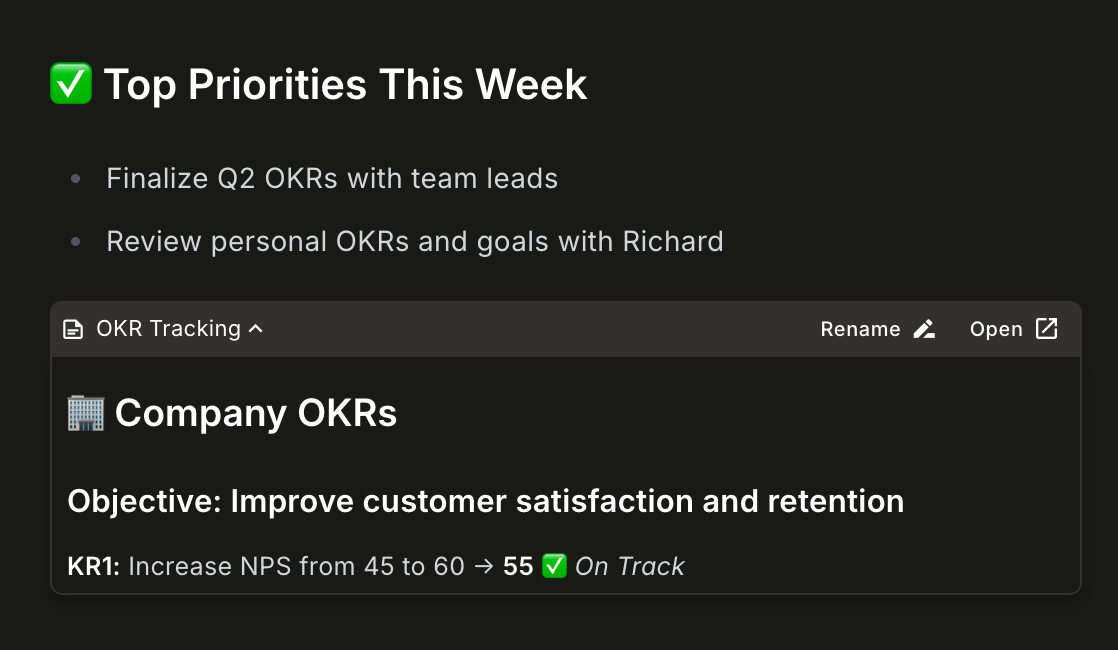
How does this fit with company OKRs? Your OKRs are commitments and belong in that category. This plan is the layer underneath: the personal allocation of your hours against the team's stated outcomes. Most OKR sets fail not because the objectives were wrong but because nobody converted them into blocks on a specific human's calendar. If your big rock has nothing to do with any team objective, notice that before the quarter starts, not during a review.
What if I miss the big rock? Sometimes you will, and it is still the better outcome. A missed big rock you can name beats a busy quarter you cannot. When you miss, you know which week it slipped, what displaced it, and whether the estimate was wrong or the capacity was. That is a diagnosis. A quarter with no named outcome produces none at all, only the vague sense that you were underwater, which will still be there in three months.
Does this replace weekly planning? No. The quarter decides what the time is for; the week decides what happens on Tuesday. Keep your weekly review and add one check: did the big-rock blocks survive?
Closing thought
A quarter can be named and a year usually cannot, because thirteen weeks is short enough to remember honestly. You can point at the week the thing slipped. Twelve months blur into a feeling, and feelings are poor inputs to planning.
Try it before the quarter turns
Run the five segments in whatever calendar and notes app you already use. All you need is somewhere to write a page and somewhere to create blocks.
What changes when the plan lives next to the calendar is the failure mode. A plan in a separate doc gets opened on day one and again on day 90. A plan attached to the blocks it produced gets seen every time you open the week, which is what survives week six. If your notes and calendar share a surface, link the plan to the first big-rock block so the checkpoint has something real to open.
 Download for Mac
 Download for Windows
 Google Play Store