Syllabus Intake: The Student Planning System That Survives Week 11
A syllabus is a complete list of every deadline for the next four months, handed to you on day one. Here is how to turn it into a work calendar in one 45-minute session, plus a 20-minute Sunday loop that keeps the term from collapsing in week 11.
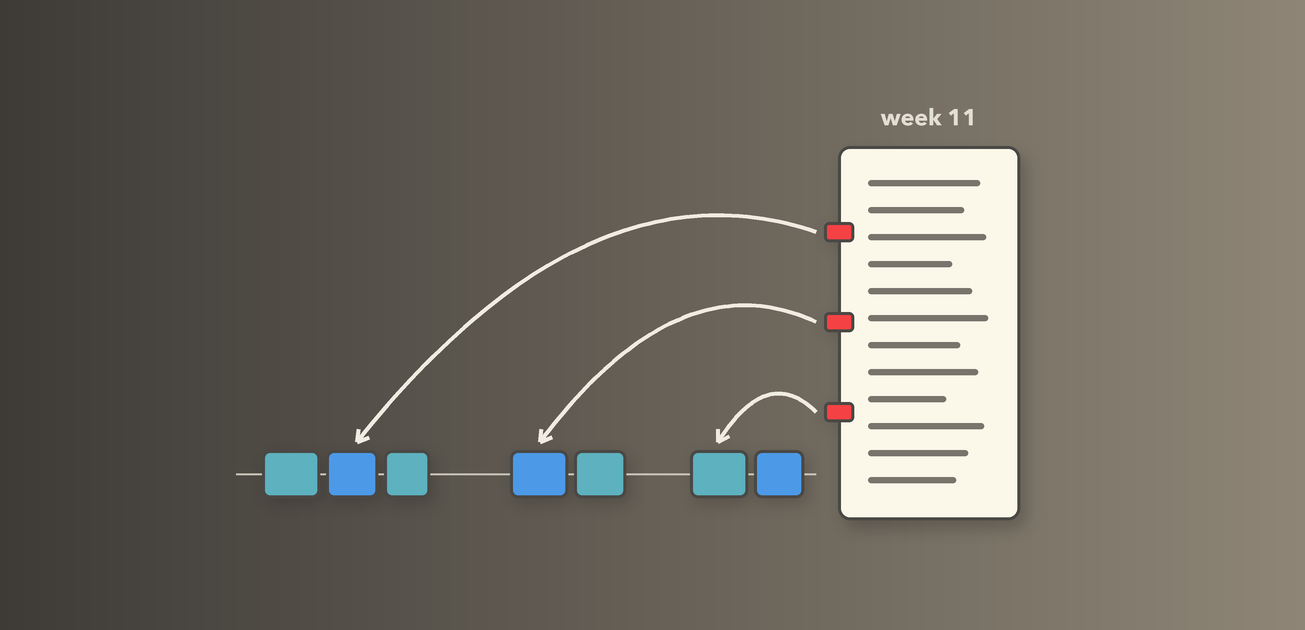
It is week 11. Monday at 11:59pm, a problem set is due. Wednesday morning is the midterm for the course you have been quietly behind in since week 6. Friday at 5:00pm is the 10-page paper worth 30 percent of your grade, the one you have thought about four times and written zero words of.
None of that is new information. All three dates were printed on documents you were handed in the first week of the term. You have had them for eleven weeks. You read them once, in the first ten minutes of the first class, and then closed the tab.
Students get something almost no professional ever gets: a complete, dated list of every deliverable for the next four months, delivered before any of the work begins. A project manager would treat that document as a gift. Most students treat it as a receipt.
A due date is a boundary, not a plan
A syllabus is a deadline calendar. What you need to survive the term is a work calendar. They are not the same object, and converting one into the other is the entire job. A deadline calendar records the moment work must stop; it says nothing about when the work starts, how long it runs, or what it displaces.
This is why knowing a deadline in advance so reliably fails to produce action. The deadline is scheduled. The work is not. Unscheduled work does not wait its turn; it competes for unallocated time against every other unscheduled thing, and unallocated time is always won by whatever is most immediate. A paper due in five weeks loses to a problem set due Thursday every time, and it keeps losing until the paper itself becomes the most immediate thing. That is week 11.
There is a second, quieter mechanism. Student weeks look identical from the outside: week 3 and week 11 have the same lectures, the same lab, the same Thursday section. The fixed part of the calendar barely changes across a term, so the calendar itself gives you no signal that week 11 is four times heavier. The load is real, but it lives entirely in the invisible part of the schedule.
A syllabus also omits the number that matters most: effort. It says "Paper 1, 10 pages, due Friday of week 11." It does not say "roughly twelve hours, in at least six sessions, two of which need a day between them so the draft can sit." You are handed the endpoint and asked to infer the volume, and almost everyone infers low.
Syllabus intake: 45 minutes, once a term
Syllabus intake is a single session in the first week of term where every deadline from every course goes onto one calendar, and every large deliverable gets its work blocks scheduled backwards from the due date. For four or five courses it takes about 45 minutes.
Minutes 0 to 10: put every date on one calendar. Open all your syllabi at once. Enter every graded item into a single calendar: problem sets, quizzes, papers, presentations, midterms, the final, and any date labeled "proposal due" or "draft due" that people skip past. One calendar, not one per course. The point is to see collisions, and collisions are invisible when each course lives in its own document. This is where you find the two deadlines landing on the same Friday in week 11.
Minutes 10 to 15: mark the fixed anchors. Lectures, labs, sections, and exams go in as recurring events. You are not planning these; you are recording them so the remaining space is visible. The white space left over is your actual budget, and it is usually badly shaped: three separate 50-minute gaps between classes are not the same resource as one clean afternoon. That is the shape problem described in time confetti, and it applies to a class schedule as much as to a meeting schedule.
Minutes 15 to 45: schedule the big deliverables backwards. For each compounding deliverable, decompose it into sessions with named outputs, then place those sessions starting from the due date and moving backwards.
Take the 10-page paper due Friday of week 11 at 5:00pm. It is not one task. It is roughly this:
- Source gathering, 90 minutes. Eight to ten candidate sources, one line of notes on each. Output: a list, not an understanding.
- Close reading, two sessions of 90 minutes. Real notes on the four or five sources you will actually use. Output: quotes and page numbers you can cite without reopening anything.
- Thesis and outline, 60 minutes. One paragraph stating the argument, plus section headers naming the claim each section makes. Output: a structure you could hand to someone else.
- Drafting, two sessions of 2 hours. Pages 1 to 5, then pages 6 to 10. Output: a complete bad draft.
- Revision, 90 minutes, at least 48 hours after the draft is done. Output: the version you would submit.
- Citations and formatting, 45 minutes.
That is a bit under twelve hours across eight sessions. Now place them backwards. Formatting goes on Wednesday of week 11, not Friday. Revision goes on Monday of week 11, which forces the draft to be finished by Saturday of week 10. The two drafting sessions land Thursday and Saturday of week 10. Outline goes in week 9. Close reading in weeks 8 and 9. Source gathering in week 7.
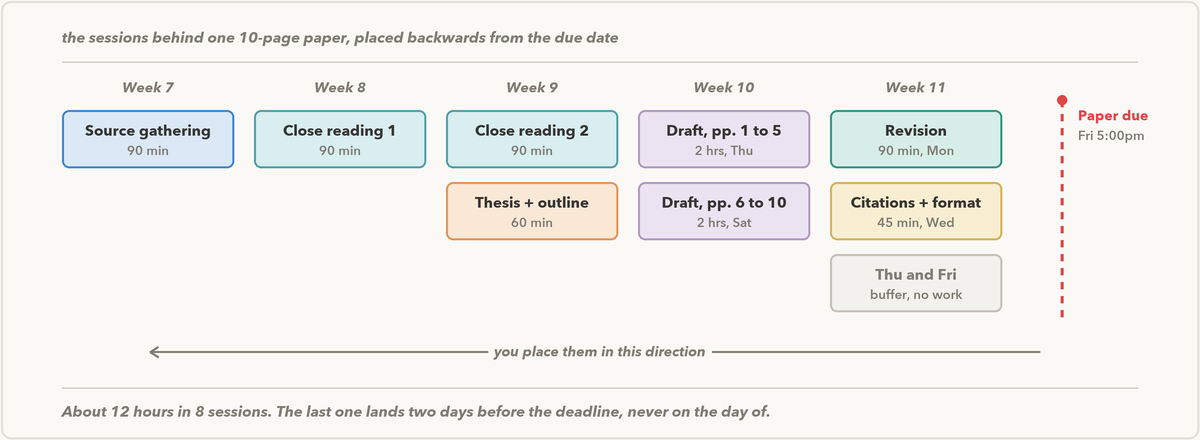
Two rules make backwards scheduling hold. First, the last session lands at least two days before the deadline, never on the day of, because those two days are your buffer against the week when everything else goes wrong. Second, every block carries its output in the title: "Paper 1: outline with section claims" rather than "work on paper." A block with a vague name is a gap with a longer label, and it will be the first thing you trade away.
Run this for every compounding deliverable. Four or five courses usually produce three to six of them.
Four kinds of academic work, and why they schedule differently
Coursework splits into four kinds. They fail in different ways, so they need different slots.
Fixed anchors. Lectures, labs, discussion sections, exams, office hours. You do not plan these; you obey them. Their only planning function is defining the shape of everything else.
Recurring load. Weekly readings, problem sets, lab reports, response papers. This work is predictable in volume and rhythm, so it should be scheduled by cadence rather than by deadline. If the problem set is posted Thursday and due the following Thursday, the block belongs on Saturday morning, permanently, as a recurring event. Attaching recurring load to its due date is what produces the Wednesday-night pattern, and the Wednesday-night pattern is what makes an ordinary week feel like a crisis.
Compounding deliverables. Papers, projects, presentations, theses. The defining property is that the output of one session is the input to the next: you cannot outline before you have read, and you cannot revise a draft that does not exist. These are the only items that require backwards scheduling, and the only ones that cannot be rescued by working harder in the final week, because the sessions have a required order and a minimum spacing.
Cram-resistant work. Anything graded on recall: vocabulary, formulas, anatomy, dates, case names, proof techniques. Hermann Ebbinghaus described the spacing effect in 1885 and it has held up about as well as anything in learning research since. Cepeda and colleagues pooled 317 experiments for Psychological Bulletin in 2006 and found the spaced version ahead in the large majority of them: the same total study time, split across separated sessions, beats the same time massed into one. That review also found something with a direct scheduling consequence. The longer you need to hold the material, the wider the gaps between sessions should be, which means studying for a December final is a structurally different problem from studying for Thursday's quiz. So cram-resistant material gets short recurring blocks, 25 to 30 minutes, two or three times a week, starting the week the material is introduced rather than the week before the exam. It is the one category where the shape of the calendar does more work than the effort you put into it.
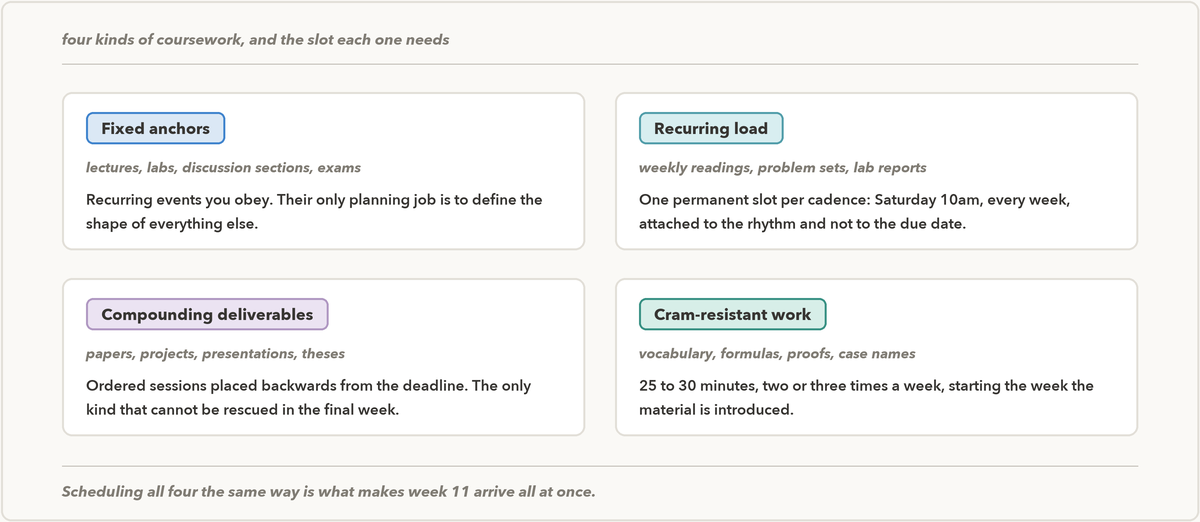
Most students already know which of their courses is which. Almost none have scheduled them differently.
The Sunday pass: a 20-minute weekly loop
Intake builds the plan. The Sunday pass keeps it true. It runs in under 20 minutes and has six steps.
- Reconcile, 3 minutes. Open last week. Mark what happened. For each block that did not happen, decide now whether it moves to a specific slot this week or gets cut. Nothing stays in the past unresolved.
- The three-week question, 4 minutes. Look 21 days ahead. For every deliverable due in that window, ask whether at least one work block for it already exists behind it. A deliverable due in three weeks with zero blocks is the most important finding of the week: schedule its first two sessions before you do anything else. This step alone is most of the value of the loop.
- Place the recurring load, 5 minutes. Confirm this week's reading and problem set blocks sit in their usual slots, and adjust for canceled lectures or a lab that runs long.
- Place cram-resistant blocks, 3 minutes. Two or three short sessions per course that has recall-heavy material. These are the first blocks people skip and the ones with the highest return.
- Count the hours, 3 minutes. Add up scheduled work hours and compare them to your real free hours after classes, commuting, meals, shifts, and sleep. If the work fills more than about 70 percent of the free time, something gets renegotiated on Sunday rather than discovered on Thursday: ask for an extension early, drop the optional reading, or push a block to next week deliberately. Seventy percent is a working threshold rather than a finding. The remaining 30 percent is what absorbs the week that goes wrong.
- Write one line, 2 minutes. In your weekly note, record what you moved and why. "Moved Paper 1 close reading to Tuesday, lab report ran three hours over estimate." Over a term this becomes the only honest record of how long your work takes, which is what makes step 5 accurate by October.
The general shape of a weekly plan is covered in 4 Steps to Building a Weekly Plan That Actually Works. The Sunday pass is that idea narrowed to a term-shaped calendar, where every deadline is known in advance and the failure mode is specifically the three-week blind spot.
Frequently asked questions
My schedule changes constantly. Does this survive that? Better than a list does, because the plan is not a promise about which hour. It is a claim on a total number of hours. The operating rule: a block you move must land somewhere before you close the calendar. Deleting a block is a decision with a consequence; moving one is free. The version of this that fails looks like three deleted blocks in a row and four hours quietly gone from a paper that nobody rescheduled.
I do not know how long an assignment will take. Estimate anyway, then measure. Put your estimate in the block title and write the actual time next to it when you finish. After two weeks you will have ten to fifteen data points and a personal multiplier. Expect to run well over on unfamiliar work and close to accurate on work you have done before. Apply the multiplier to future estimates and recalibrate at midterm. The estimate does not need to be right in week 1; it needs to be honest by week 4.
How do group projects fit into this? Group work has a dependency your calendar cannot control, so build slack into the part you own. Set the group's internal deadline one full week before the real one and schedule your blocks against the internal date. Then bring your decomposed session list to the first group meeting. A group that argues about who does what will stall; a group handed a list of eight named sessions will usually just claim them.
Does this work with a heavy course load and a job? It works better, because step 5 becomes the important one. When free hours are genuinely scarce, the value is not fitting more in. It is discovering in week 6 that the term does not fit, while dropping a course, changing a shift, or asking for an early extension is still available to you. When a professor moves a deadline mid-term, step 1 absorbs it: re-planning takes about 90 seconds once the sessions exist as blocks you can drag.
Closing thought
The syllabus is the only document in your life that tells you the future and asks nothing in return. It is written before the term starts, handed to everyone, and then ignored until it becomes a threat. Reading it in September as a list of things that will happen to you is a choice. Reading it as instructions for what to put on a calendar is a different one, and it costs 45 minutes.
Run the intake in whatever calendar you already use. The mechanics need nothing special: one calendar, blocks with real names, and a Sunday habit. What changes when the notes for a block live next to the block is that Tuesday's paper session opens onto the actual outline rather than a search for it, and the twelve hours you scheduled stay twelve hours instead of quietly becoming fifteen.
If you need somewhere to put it, nocal is free with a .edu address and the student setup covers the calendar and weekly note side.
 Download for Mac
 Download for Windows
 Google Play Store