The shadow calendar: the hours your meetings cost but never book
A 30-minute meeting is almost never 30 minutes of cost. The prep, recovery, follow-up and coordination it generates never get booked, so they get paid out of whatever time looked free. Here is how to measure your own overhead ratio in one week, and what to do with the number.
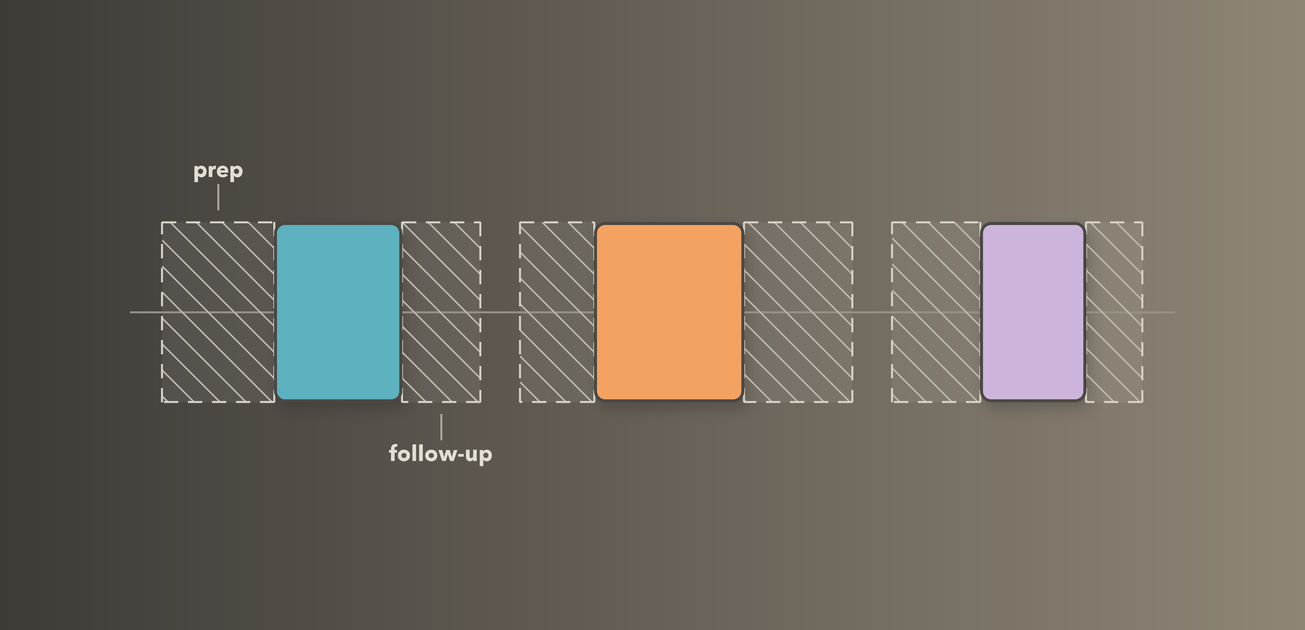
Your Tuesday had three hours of meetings on it. A 10:00 planning review, a 1:00 vendor renewal call, a 2:30 one-on-one, and a 4:00 incident retro. Three hours booked, five hours open, and you were finally going to write the migration doc in the open five.
Here is where the five went. At 9:20 you opened the planning deck, because you had not read it and you were presenting slide six. That was forty minutes. The review ran to 11:00 and you spent until 11:25 writing down the two things you had just agreed to own. Lunch was short, because at 12:40 you pulled last year's invoices so the vendor call would not be a fishing expedition. The call ended at 1:30 and left you owing the vendor an email by end of day, which you wrote at 1:50, after twenty minutes of not quite starting anything else. The one-on-one needed no prep, but the promise you made inside it became a Slack message, a ticket, and an invite you sent at 3:15. The retro at 4:00 produced notes that had to go somewhere before they evaporated.
At 5:40 you looked at the migration doc, which had a title and one paragraph, and concluded you had wasted the day.
You did not waste the day. You worked the entire day. About three hours of it were on the calendar. Most of the rest was the meetings too, just not the part anyone books.
The shadow calendar
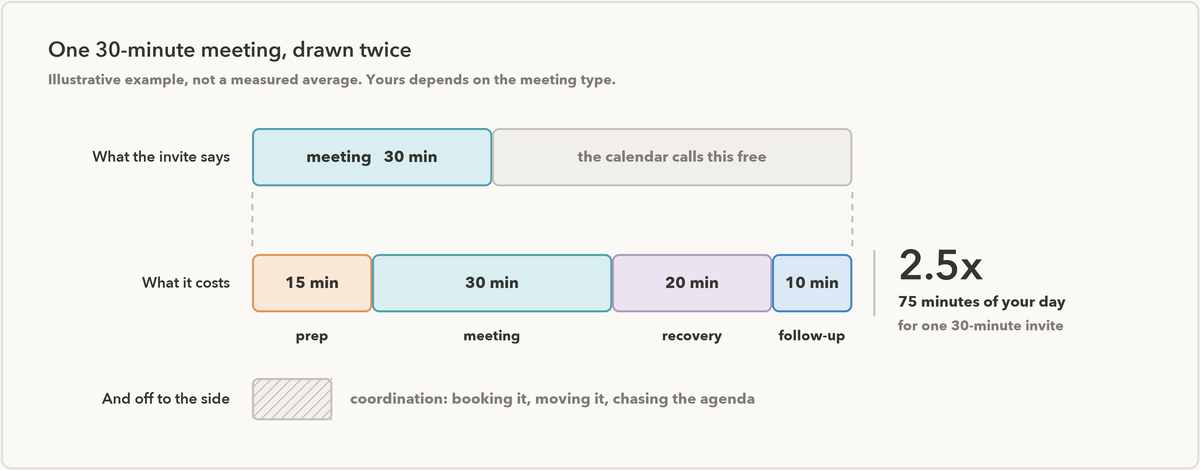
Every meeting has a second meeting attached to it that nobody schedules: the work required to show up usefully, and the work created by having shown up. That second set of blocks is the shadow calendar. It is real, it is mandatory, it has deadlines, and it appears nowhere in the grid you use to decide whether you have time for something.
This is not a metaphor for feeling busy. It is an accounting error. When you see three hours booked on Tuesday, you are reading a number that describes only the synchronous portion of your commitments. You then plan the rest of the day against that number, and the rest of the day loses.
Why the overhead is structurally invisible
A calendar event is a container for one thing: a block of time when several people are in the same conversation. Start, end, attendees, location. There is no field for "this will cost you two hours." The closest anything has shipped is the travel time setting in Apple Calendar, which reserves the drive and nothing else. The format was built to resolve scheduling conflicts, not to account for work.
So the overhead has no container. Three consequences follow.
Uncontained work colonizes whatever is adjacent. Prep has a hard deadline: the meeting starts at 10:00 whether or not you have read the deck. Follow-up has a fast-decaying one: the notes are worth writing at 11:05 and nearly worthless the next day. Both preempt whatever was nominally occupying the surrounding gaps. Your focus block does not lose to the meeting. It loses to the meeting's shadow, which arrives without an invite.
Nobody's estimate includes it, including yours. When a colleague books thirty minutes of your time, they are being honest: they are asking for thirty minutes. When you accept, you weigh the meeting against thirty minutes, because thirty minutes is the number on the screen. The comparison you should be making is against the true cost, which you have never measured.
Recovery does not look like work. Sophie Leroy's research on attention residue describes what happens when you switch between tasks: part of your attention stays stuck on the previous one, well past the moment of switching. Gloria Mark's fragmented-work studies at UC Irvine measured how long people took to get back to the task they had been pulled off, and the average ran past twenty minutes. Neither cost appears as an event. They appear as a stretch of afternoon where you were slow and could not explain why.
If your gaps are already too small to be useful, the shadow work lands in them anyway and the day disappears faster. I wrote about that interaction in Time confetti. This post is about a different quantity: not the shape of the gaps, but the unbooked load attached to each individual meeting.
The four kinds of shadow work
The overhead is not one thing. It comes in four kinds, each failing by a different mechanism, which is why one fix never covers all of it.
Prep. The work that must happen before the meeting or the meeting fails: reading the doc, pulling the numbers, forming an opinion you can defend. Prep is the only shadow category with a hard external deadline, which is why it wins fights against everything else in your morning. It is also the most compressible: it expands to fill the time available, and a deliberate twenty-minute block often produces the same readiness as a panicked forty.
Recovery. The reorientation cost after the meeting ends. This is not work at all, which is what makes it so hard to see: no artifact, no output, nothing you could delegate. It is the twenty-odd minutes where you are technically at your desk and functionally still in the previous conversation. You cannot organize your way out of it. You can only pay it less often, by clustering meetings rather than spreading them.
Follow-up. The artifacts the meeting created: the notes, the ticket, the promised email, the decision that needs writing down before three people remember it three different ways. Done in the twenty minutes after the meeting, this is fast and accurate. Done the next morning, it takes noticeably longer and loses fidelity, because you are reconstructing rather than recording. Almost all the pain of follow-up comes from deferring it.
Coordination. The work of the meeting existing as an object: finding a slot, rescheduling when someone declines, chasing an agenda that never arrived, sending the recap to whoever could not make it. Coordination scales with participants and reschedules, not with length. A fifteen-minute meeting rescheduled twice across six calendars can cost more than a ninety-minute workshop that happens once as planned. It is also usually paid by someone other than the attendees, which is why it goes unnoticed.
Measuring your own overhead ratio
There is no universal multiplier, and you should distrust anyone who gives you one. The ratio varies by meeting type, by role, and by how much of your job is presenting rather than attending. What you need is your number, per type, measured on your own calendar. It takes one week and about three minutes a day. Do not change your behavior while measuring; you are taking a baseline, not running an experiment.
For each meeting, write four numbers directly on the event, in the description field or the attached note: prep, recovery, follow-up, coordination, in minutes, rounded to the nearest five. Record them at the moment. The estimate you make at 11:05 is roughly accurate; the one you make at 6:00 is fiction.
At the end of the week, group by meeting type and compute a ratio for each group: total time, including the four shadow numbers, divided by scheduled duration. A meeting you walk into cold and walk out of clean lands near 1.0. A review you have to present at will not.
A finished week, with numbers invented to show the shape rather than borrowed from anyone's calendar: standup at 1.1, essentially free. One-on-ones at 1.4, almost all follow-up. The weekly product review at 2.2. The monthly customer advisory call at 4.1, which is ninety minutes on the calendar and a bit over six hours in total, most of it prep and a recap document nobody had ever named as anyone's job.
Your own version will produce different numbers. What it produces reliably is a short list where one line is visibly worse than the rest, and that is the meeting worth arguing about.
The true-cost pass
Four steps. The first takes a week; the rest take under thirty minutes and then become standing rules.
1. Trace and write down the multipliers, one week plus ten minutes on Friday. Run the measurement above, then record the result in one file, one line per meeting type: "1:1s, 1.4, mostly follow-up. Product review, 2.2, mostly prep." You will refer to that line every time you make a scheduling decision this quarter, so keep it next to the calendar it describes, in your weekly note or wherever you already plan.
2. Book the follow-up to the meeting itself, ten minutes. For every recurring meeting longer than thirty minutes, create a fifteen-minute block starting the moment it ends, titled after it: "Product review: close out." Not a generic buffer later in the day. It has to be attached, because the value comes entirely from doing the follow-up while the meeting is still in your head. This is the highest-return change in the procedure.
3. Book prep only where the ratio says prep dominates, fifteen minutes. Add prep blocks for the two or three meeting types where your trace showed prep above roughly a third of the total, and size each block to the trace rather than to what feels generous. For anything requiring you to form an opinion, schedule it the day before; opinions do not form well under time pressure.
4. Re-run the accept test at true cost, fifteen minutes. This is the step that changes the calendar. For each recurring meeting, write the honest cost next to it: not "30 minutes," but "30 minutes plus 45 of shadow, so an hour and a quarter." Then ask the question you have been asking wrong: does this earn an hour and a quarter of my week, every week? Some will. Several will not, and those are the ones you have been approving at a discount for months. A high ratio is not by itself a verdict: an advisory call at 4.1 may still be the cheapest way you have of hearing what a customer actually thinks. A weekly sync at 1.4 that ends without a decision is the easier call, and it usually survives the move to a written update.
Step four pairs well with the recurring-meeting audit in Calendar debt. The audit asks whether a meeting's original reason still holds. The true-cost pass asks whether it is worth what it actually costs. A meeting can have a valid trigger and still fail on price.
Frequently asked questions
I cannot book prep and follow-up for every meeting. My calendar would be completely full. Yes. That is the finding, not the objection. Your calendar is already full; the difference is that the full version is currently invisible, so you keep making commitments against time that was already spent. Booking the shadow does not add work to your week. It moves existing work from the unaccounted column to the accounted one. If the accounted version looks unsurvivable, that is the real state of your week, and it is better to be looking at it.
Recovery is not something I can put on a calendar. Am I supposed to book "sit still for twenty minutes"? No. Recovery is the one category to reduce structurally rather than book. Two moves do most of the work: cluster meetings back to back so you pay one recovery cost instead of three, and stop scheduling anything cognitively demanding in the thirty minutes after a meeting ends. The follow-up block from step two does double duty here, since closing out a meeting is the one task that does not require recovering from it first.
How is this different from time confetti or calendar debt? Time confetti is about the shape of your free time: fragments too small to use. Calendar debt is about recurring meetings whose original justification expired. The shadow calendar is about the unbooked work attached to any individual meeting, including new ones and ones you are glad to attend. A perfectly justified meeting still has a shadow.
I am not the organizer. I cannot change the meeting. You do not need to. Every step except the last runs entirely on your own calendar and requires no one's agreement. Booking a close-out block after someone else's meeting is not a negotiation. And when you do raise it, a measured number changes the conversation: "this costs me about ninety minutes a week" is much harder to wave away than "I am busy."
Should the shadow blocks be visible to my team, or marked private? Visible, with clear titles. A block called "Product review: close out" tells a colleague something true about how the work happens, and it protects better than a wall of blocks labeled "busy," which reads as time hoarding and invites people to book over it.
Closing thought
Meetings feel more expensive than they look because the calendar was never built to show you the price. It shows the appointment. Everything the appointment requires and everything it creates gets settled quietly, out of hours you had already promised to something else.
Run the trace in whatever calendar you already use: four numbers per meeting, five days, a Friday to add them up. The mechanics work in any tool where you can type into an event.
What changes when notes live next to the calendar block is where those numbers end up. If the record of what a meeting cost sits inside the meeting, you have the evidence in hand the next time the invite arrives. If it lives in a separate app, you will have the feeling and not the number, and the feeling loses every argument.
 Download for Mac
 Download for Windows
 Google Play Store