Calendar Hell: What a Cursed Calendar Actually Looks Like
We built a free tool that reads the last 28 days of your calendar and scores it 0-100 on ten specific failure patterns. Here is what each of those ten sins actually measures, why each one is costly, and a 20-minute exorcism that fixes the heaviest ones.
It is 4:40 on a Thursday and you are looking at tomorrow. Nine events. Four of them recur. Two of them overlap between 11:00 and 11:30, and you have not decided which one you are actually attending. The longest uninterrupted stretch on the whole day is 35 minutes at 2:15, and you already know what will happen to it.
Nothing about tomorrow is unusual. That is the part worth paying attention to.
We built a free tool called Calendar Hell that reads a 28-day window of your calendar and puts a number on that feeling. It scores you 0 to 100, ranks you against other calendars, and hands you one of twenty personas. It is deliberately mean about it.
This post is the serious version. The score is the sum of ten detectors, each measuring one structural failure, and those ten patterns are worth knowing whether or not you ever run the scan. Each has a different cost and a different fix.
A cursed calendar is not a full calendar
A full calendar has a lot of hours on it. A cursed calendar is one whose shape prevents the work those hours were meant to support. The two come apart constantly.
Twenty-two hours of meetings clustered into Tuesday and Thursday, leaving the rest of the week mostly open, is full and not cursed. Fourteen hours sprinkled evenly across five days, each meeting separated by 25 minutes, is less full and much more cursed. The second person has more free hours and less usable time. This is why "I am too busy" is a bad diagnosis. Busy is a volume claim. Almost every calendar problem worth fixing is a geometry problem.
Calendars drift toward the bad geometry because they have no negative feedback loop. Every default in every scheduling tool is additive: creating an event takes four seconds, removing a recurring one requires a conversation. Nobody is asked, weekly, whether the standing sync should continue. The absence of that prompt is the entire mechanism.
Fragmentation is what the additive default produces, and it is expensive in a way the grid does not show. Sophie Leroy's 2009 work on attention residue found that switching between tasks leaves part of your attention stuck on the previous one. Gloria Mark's observational studies at UC Irvine measured what that does to a working day: when someone was pulled off a task and got back to it at all, they had passed through roughly two other pieces of work first, and about 25 minutes had gone by. Brigid Schulte's Overwhelmed named the resulting shape: time confetti, free time arriving in pieces too small to use. If your gaps are routinely shorter than the interval it takes you to find your way back, the calendar reports capacity the day will never deliver. We covered that geometry in time confetti and calendar fragmentation. Calendar Hell turns it into a measurement.
How the score is actually built
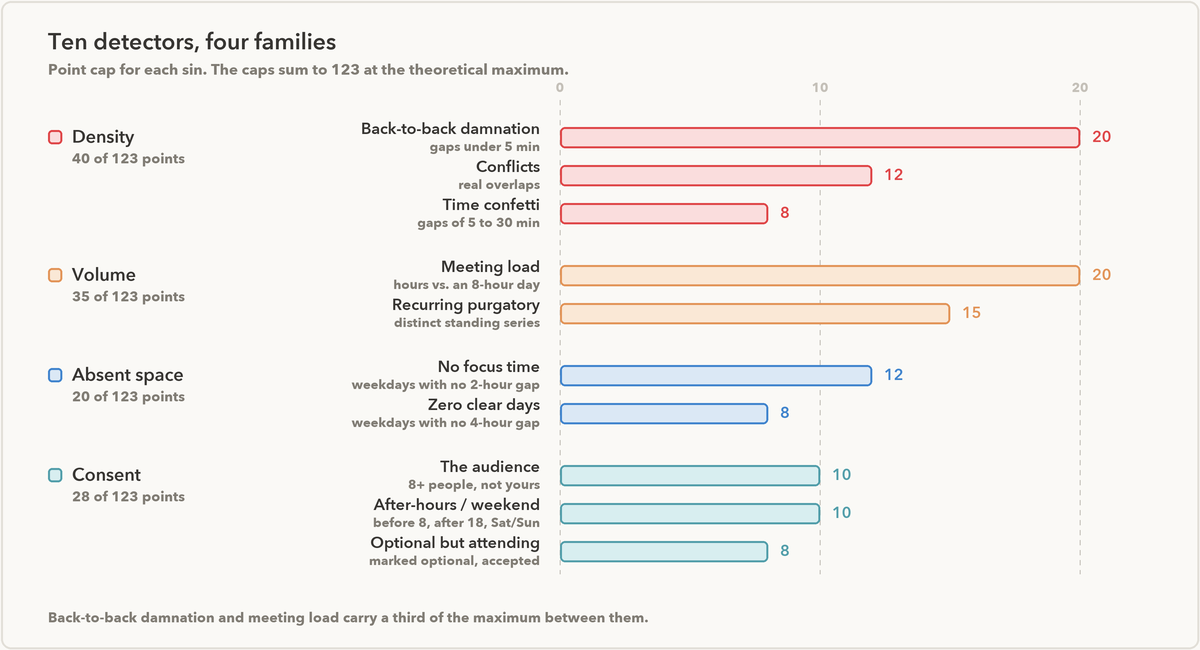
Ten detectors run against a 28-day window: the three weeks before this one plus the current week. Each returns a point value with a hard cap, and the caps sum to 123 at the theoretical maximum.
That raw total is curved rather than divided. Fifty points out of 123 is 41 percent of the maximum, but the score it produces is 57, because the curve lifts the middle of the range on purpose. A calendar with four or five real problems on it should not be allowed to read itself as fine.
Three things the engine ignores, because they produced false accusations in testing. All-day and multi-day events are dropped, so a week of all-day travel does not read as 168 hours of back-to-back meetings. Declined and cancelled events do not count. Informational holds are removed before conflicts are counted, so a meeting landing on your own focus block is not a double-booking; every overlap reported is two real commitments fighting for one slot.
The finished score falls into one of five bands. Ascended is 15 and under. Lightly singed runs to 39, the middle to 64, cooked to 84, and catastrophic is 85 and up.
Then it ranks you, and the benchmark it ranks against is the part worth arguing with. It is a sample of 80 real calendars, filtered to active ones: anything with less than two scheduled hours a week is thrown out, so a dead account cannot pad the bottom of the distribution and flatter a genuinely light week. That sample spans 7 to 98. Its median sits in the middle band, in the mid-50s, and close to 40 percent of it lands in cooked or catastrophic. Once a few hundred real scans have accumulated, the seed sample drops out entirely and you are ranked against the people who ran the scan instead.
The ten sins, in four families
The ten sort into four families, and the family is what tells you which kind of fix applies. Density and absent space you can fix alone, this week, without telling anybody. Volume and consent require you to say something to another person, which is why they are the ones that stay broken.
Family one: density
Back-to-back damnation counts every transition between two events with under 5 minutes between them, and tracks your longest unbroken chain. It charges 1.5 points a transition and caps at 20, so fourteen of them inside a month maxes it out. The damage is downstream of the meetings themselves: a chain of four gives you no point at which to write down what the first three decided. Decisions made in a chain evaporate. Fix: change your default meeting length from 30 and 60 to 25 and 50. That one setting breaks most chains automatically.
Conflicts counts genuine overlaps between two real commitments, at 3 points each. That is the highest per-event penalty anywhere in the engine, and the cap of 12 means four double-bookings in a month is a maximum score. The price is set that high because a conflict is not really a scheduling failure. You already know which of the two you are attending. You have simply not told the other room, and you are going to tell them at 10:58. Fix: open the next 14 days and decline one side of every overlap today. Now it is free; at 10:58 it costs the other attendees their agenda.
Time confetti counts gaps between 5 and 30 minutes long, one point each, capped at 8. The cap sits low on purpose: a handful of short gaps is unavoidable in any real job, and the ninth one is not meaningfully worse than the eighth. The raw count is the number to read, because it keeps climbing long after the points stop. Forty of them in a 28-day window means your day is structurally made of scraps. Fix: find one day this week with two short gaps separated by a movable meeting, and move it. Two 25-minute scraps plus a 30-minute meeting become an 80-minute block.
Family two: volume
Meeting load takes your scheduled hours as a ratio of available working hours, assuming 8-hour business days, and it hits the 20-point cap at 80 percent. That number was written expecting nobody would reach it. People reach it. Past roughly half your working hours the leftovers are all interstitial, and interstitial time cannot hold work that takes sustained thought, which is why the ratio tells you more than the raw hours do. Fix: not solvable in a week. Measuring it is, because "I am in meetings 61 percent of my working hours" is an argument and "I am swamped" is not.
Recurring purgatory counts distinct recurring series and the hours they consume: 2 points per series, plus a third of a point per hour, capped at 15. It is scored separately from meeting load because recurring meetings decay differently. A one-off meeting either produced a decision or did not, and you know within a week. A standing meeting survives on the inertia of its own existence. Fix: run the four-question audit from calendar debt against your recurring list. Budget 30 minutes.
Family three: absent space
No focus time counts weekdays carrying more than one event where no gap between events reaches 120 minutes, at 2 points a day, capped at 12. Two hours is the threshold because below roughly 90 minutes, setup and recovery consume enough of the block that you are doing shallow work whether it feels that way or not. Fix: book one 2-hour block, on one day, for one named task. Not "focus time." Write "draft the Q3 architecture review" so the block has something to defend itself with.
Zero clear days is the coarser sibling, counting weekdays with more than one event and no gap reaching 240 minutes. It caps at 8, which six such days will reach. The question it asks is blunter than the previous one: was there a day this month on which a real project could have moved at all? Fix: declare one no-meeting day per week and mark it as a recurring all-day busy block. It will not stop anyone determined, but it changes the default from "this slot is free" to "this requires asking."
Family four: consent
The last three sins say nothing about geometry. They measure how much of your calendar you actually agreed to.
The audience counts meetings with 8 or more attendees that you did not organize, 1.2 points each, capped at 10. Eight is where the format changes: below it you are in a conversation, above it you are watching a broadcast with your camera on. Fix: pick the three worst and ask each organizer, in writing, "Would notes or the recording cover me for this one?" The answer is yes more often than the asking feels like it will be.
After-hours and weekend counts events starting before 8:00 or ending after 18:00, plus anything with two or more attendees landing on a weekend, at 1.5 points each, capped at 10. A solo evening event only counts if it is genuinely off-hours, so a Saturday gym block is scored more gently than a Saturday status call. Fix: set working hours so booking links stop offering those slots, then move the one recurring meeting that most consistently sits outside them.
Optional but attending counts events where you were marked optional and accepted anyway, capped at 8. This is the cleanest evidence the engine collects, because the organizer already told you in writing that the meeting does not need you, and you overrode them in writing back. Fix: decline the next three, with one line offering to read the notes.
Twenty personas, and why the rare ones are not the good ones
Alongside the score, the tool assigns one of twenty archetypes, sorted into four rarity tiers on population share alone: Common above 9 percent of calendars, Uncommon from 6 to 9, Rare from 2 to 5, Mythic at 1 percent and below. The persona keys mostly off the pattern that dominates your calendar rather than off your score, so it is a shape diagnosis and not a severity one. The Back-to-Back Gladiator, the Audience Member, the 1:1 Machine, the Family Logistics Director and the Nightshift Martyr name different problems with different fixes, at any score. Calendars carrying under two scheduled hours a week are gated into a separate group of three, so a near-empty calendar cannot be diagnosed as a meeting problem. The tool is characteristically unkind about that too:
Either you have achieved enlightenment or you are unemployed. We cannot tell. Can you?
Rarity here is population share and nothing else. Ranked that way, the deck says something the score on its own does not.
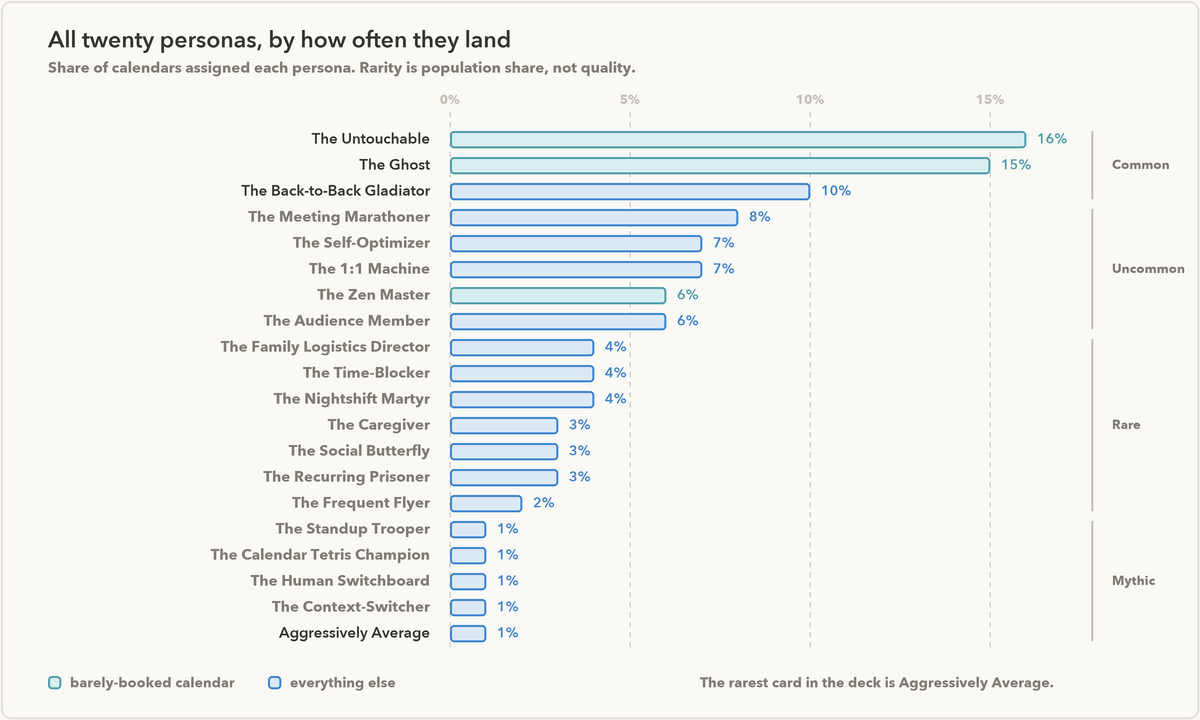
The two most common personas are The Untouchable and The Ghost, at 16 and 15 percent. Both are barely-booked calendars. Neither belongs to someone who would go looking for a calendar tool. Among calendars that actually have things on them, the leader is The Back-to-Back Gladiator at 10 percent, then The Meeting Marathoner at 8. Density first, volume second, in the same order the point caps put them.
Five cards sit at the 1 percent floor, and the last of them, ranked twentieth of twenty, is Aggressively Average: evenly spaced meetings, forever, a calendar with no personality. It is Mythic tier. Almost nobody gets handed it, because almost nobody's calendar is generic. Calendars fail in specific, nameable ways, and the specific way yours fails is the only part of the diagnosis you can act on.
The 20-minute exorcism
Run this once, with your calendar open. It targets the heaviest sins, and every step finishes inside its stated time.
Minutes 0-2: change your default event duration. In Google Calendar, tick "Speedy meetings" under Settings, General, Event settings: a 30-minute event then ends 5 minutes early and anything an hour or longer ends 10 minutes early. Outlook's version is "Shorten duration for all events," under Settings, Calendar, Events and invitations, and it makes you pick the amounts yourself. Set them so 30 becomes 25 and 60 becomes 50, for everything you schedule from now on. Highest-leverage two minutes on the list.
Minutes 2-6: clear your conflicts. Open the next 14 days. For every genuine overlap, decide now which meeting you are attending and decline the other with a one-line note. Do not mark it tentative. Tentative is the conflict, renamed.
Minutes 6-11: merge one confetti cluster per day. Go through the next five business days. On each, find the two shortest gaps and ask whether a single meeting between them can move. If yes, send the request now, while the day is still soft. This adds no minutes to the week. It converts minutes you already had into the only shape they are usable in, and the shape holds: putting a meeting back into a named block means stepping on something, where putting one into an open stretch means nothing at all.
Minutes 11-15: kill three optional meetings. Filter the next two weeks for anything marked optional, plus anything with 8 or more attendees you did not organize. Pick three. Decline with the same line each time: "Skipping this one to protect a block. Happy to read the notes." Send all three in one sitting, so you pay the social cost once.
Minutes 15-18: place one real focus block. Pick next week's lightest day. Book two hours. Title it with the task, not the word "focus." Then write the first sentence of that task somewhere the block can reach, so it does not open on a blank screen.
Minutes 18-20: schedule the next pass. Put a monthly 20-minute event on your calendar titled "calendar exorcism." Everything above undoes itself within about six weeks. Recurrence is the only defense against recurrence.
Frequently asked questions
Does a low score mean I have a good calendar? Not necessarily. A very low score means one of two things: you protect your time, or almost nothing is scheduled. Below two scheduled hours a week the engine scales the score down toward zero, so an empty calendar reads as empty rather than enlightened. That is as far as the arithmetic can get. It cannot tell a well-defended week from an unemployed one. Neither can its copy, which says so out loud.
Why does my personal calendar score so differently from my work one? They are structurally different objects. A personal calendar is mostly solo events, all-day items and evening commitments, and the engine treats those differently: a 7:30pm gym block is not scored like a 7:30pm status call. Connect only the personal one and expect a lower number and a persona about your life rather than your job.
What if the meetings genuinely are not mine to cancel? Nothing in the protocol asks you to cancel a meeting you do not own. Changing your default duration, declining one side of a conflict, declining an optional invite, placing a block and booking the next pass are all moves you make alone. Only the gap-merging step needs someone else to say yes, and it asks them to move a meeting rather than lose one. Meeting load is the single sin that requires a real negotiation, which is exactly why you want the measured number before the conversation rather than after it.
Does the tool store my calendar? It reads the 28-day window, computes the score, and keeps the result so the percentile means something. Event titles are never written to storage. What is kept is the score, the sin breakdown, and a stripped free/busy grid carrying start times and a category label and no event content at all. It is a scoring toy, not a sync.
Closing thought
A bad calendar is hard to fix because no single event on it is indefensible. Every meeting had a reason, every overlap had a moment where accepting was easier than deciding, and every 25-minute gap was created by someone being polite. The damage is entirely in the aggregate, which is the one view the grid never shows you.
Run the scan, then run the protocol
Calendar Hell reads the window and ranks the ten sins by how much damage each one did to your month. Take the top two, run the exorcism against those, re-scan in a month.
The protocol works in whatever calendar app you already have. What changes when notes live next to the calendar block is narrow but real: the block from step five opens with its task already written beside it, and the decisions from step two are recorded where you will find them at the next audit. That is the difference between a calendar you look at and one you work out of.
 Download for Mac
 Download for Windows
 Google Play Store