Meeting-free days are a policy, not a preference: why No-Meeting Wednesday erodes in three weeks
A meeting-free day announced as a norm loses to urgency, because enforcement runs downhill and every exception to it is genuinely reasonable. Here is the structural reason that happens, the four design choices that decide whether the day survives, and a six-week rollout that holds.
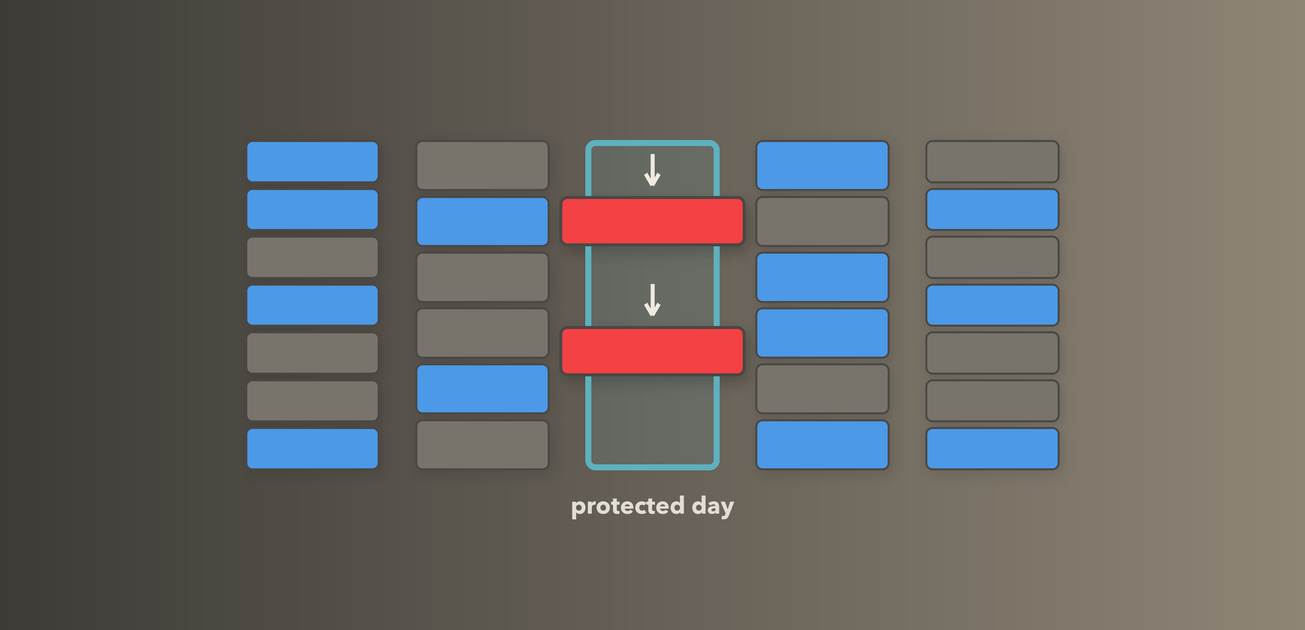
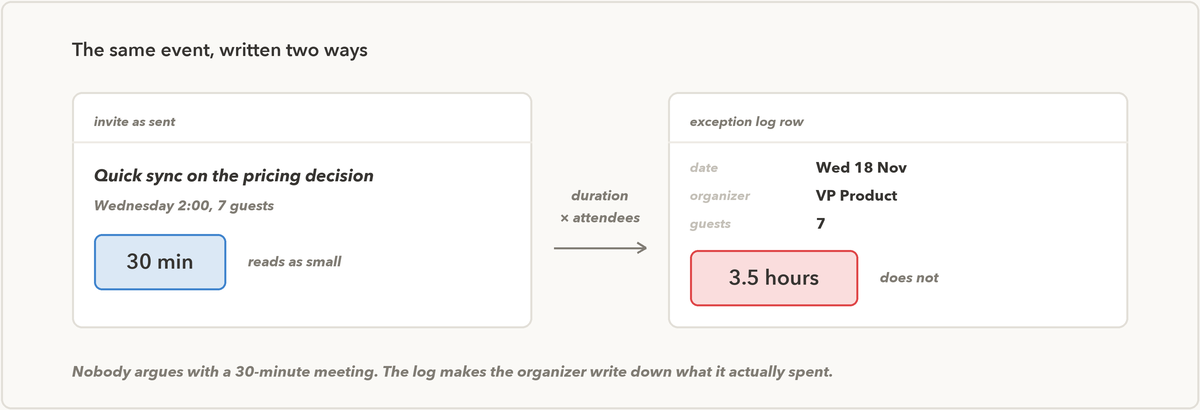
It is the third Wednesday. The company announced No-Meeting Wednesday at an all-hands a month ago, and the first two held. Then at 4:40 on Tuesday afternoon, an invite lands: "Quick sync on the pricing decision, 30 min, sorry to break the Wednesday rule, only time that works before the board deck goes out." The organizer is a VP. Seven people are on the invite.
Everyone accepts. Every one of them is right to accept. The pricing decision is real, the board deck is real, and declining costs more than thirty minutes.
The next Wednesday, two meetings appear. The week after that, four. Nobody sends a note announcing that No-Meeting Wednesday is over.
It is over.
Quiet repeal
Nothing in that sequence was a decision. That is what quiet repeal looks like: the policy is never canceled, it is exhausted, one legitimate exception at a time, and the exhaustion runs fast enough that nobody registers it as a choice anyone made.
The usual diagnosis is cultural. The team did not buy in. Leadership did not model it. That diagnosis is wrong in a way that matters, because it points the fix at exhortation: another all-hands, a firmer Slack post.
The failure is structural. A meeting-free day announced as a norm will lose to urgency every time, for three reasons that have nothing to do with how much anyone cares.
Why norms lose to urgency
Asymmetric cost. The person scheduling a meeting saves their own time by spending everyone else's. The VP avoided forty minutes of writing a decision doc. Seven people paid thirty minutes each, which is three and a half hours, and the real bill is higher once you count what a 2:00 meeting does to the hours on either side of it. That second-order cost is the subject of time confetti, and none of it appears on the organizer's calendar. A meeting-free day is a shared resource anyone can draw down and nobody is charged for. Resources with that shape do not survive on goodwill.
Exception legitimacy. What destroys a commons is not bad actors. It is good ones. Every individual violation of a meeting-free day is genuinely reasonable, which means refusing it looks unreasonable. And the refusal is structurally disadvantaged: the person asking has a specific, concrete, urgent need, while the person refusing has a general, abstract principle. Specific beats general in a live conversation, no matter who is right. Notice that in the cold open nobody had to be persuaded. The policy simply had no way to answer.
The seniority gradient. Enforcement runs downhill. When a VP books Wednesday, it is an exception. When an engineer books Wednesday, it is a violation. Once that asymmetry is visible even once, the policy stops being a rule and becomes a status marker: booking Wednesday is a perk of rank. That is worse than having no policy, because it teaches people what rules are actually for here, and the lesson generalizes to the next one you announce.
Two pieces of published research describe the conditions the policy has to survive. Microsoft's 2025 Work Trend Index, which reads aggregated Microsoft 365 usage signals rather than asking people to estimate their own week, reports that 60 percent of meetings are now ad hoc rather than scheduled, and that employees are interrupted every two minutes during core working hours. Asana's Anatomy of Work Index, a survey of more than ten thousand knowledge workers, puts 103 hours a year per person into meetings the attendees themselves called unnecessary.
Of those two numbers, the first is the harder one for a meeting-free day. A recurring meeting can be moved off Wednesday once and it stays moved. An ad hoc meeting is created by someone who was not thinking about the policy in the moment they created it, and it gets created again next week by someone else.
The most instructive case on record is Shopify. In January 2023 the company deleted every recurring meeting with three or more attendees, told people not to re-add them for at least two weeks, limited meetings over fifty people to a single six-hour window on Thursdays, and reinstated meeting-free Wednesdays. It expected the purge to clear roughly ten thousand calendar events.
The word worth sitting with is reinstated. Shopify already had a meeting-free Wednesday. It had to be brought back, which means it had gone away, at a company whose leadership was willing to delete ten thousand events in a morning to get it back.
Borrow the case carefully, though. That is a January 2023 announcement, and there is no public accounting of what survived it. Whether Wednesday held through 2024 and after is not something anyone outside Shopify can check, which is the argument rather than a hole in it. The interesting part of that announcement was never the deletion count. It was the two-week cooling-off period, the one clause that made putting a meeting back cost something.
The four design choices that decide whether it survives
Two companies can announce the same policy and get opposite results. The difference comes down to four design decisions, most of which are never explicitly made.
Scope. A company-wide day protects more surface area and has a much larger blast radius when it breaks. A team-level day survives better for three reasons: the group sharing the day also shares a manager who can enforce it, exceptions originate inside the group where their cost is visible to the person creating them, and the day can be chosen against that team's real load rather than an average. The honest cost is leakage. Invites from other teams still land, and nothing in a team-level policy binds the people sending them, so the day you protect will be most of a day rather than all of one. Start team-level anyway, and expand only after one team has held it for a quarter with data.
Granularity. A full day produces a genuine maker day, and contiguity is the point: two four-hour stretches beat eight scattered hours. But a full day is a large target, and it displaces a whole day of meetings onto four other days. A recurring protected block, say 9:00 to 1:00 daily, survives better and is easier for an individual to defend without invoking a policy at all. The tradeoff is that four hours falls short of a maker day, and blocks get nibbled from the edges. Rough rule: work whose unit is larger than a day, such as design, writing, or architecture, justifies the full day. Support-shaped or on-call work does better with blocks.
The exception mechanism. There has to be one. A policy with no exception path does not become stricter, it becomes ignored, because the first genuine emergency proves it unworkable and everything after that is precedent. But the exception has to cost something. An exception with no friction is just the new default. Three designs work: a named approver whose approval is a public act, a required one-sentence justification in the invite description stating what breaks if this waits until Thursday, or a public log. The friction does not need to be large, only non-zero and observable.
The one-sentence version is the cheapest to run, and it changes what gets sent. Under it, the VP in the cold open has to type something like "pricing decision, board deck goes to the printer Thursday 9:00, cannot slip" into the invite description before sending it. Half the time that sentence is easy to write and the meeting deserves to happen. The other half, writing it is the moment the organizer notices they are asking seven people to cover for a document they did not write. You are not blocking real urgencies. You are making the organizer feel a cost they currently push onto other people's calendars.
Enforcement asymmetry. The policy has to bind upward harder than downward. If a director's exception is rubber-stamped and an IC's is questioned, everything else you designed is decoration. This is the one choice with no tradeoff: the credibility of the whole policy is set by the first senior violation and how visibly it is handled. If you are not willing to log an exec's exception in the same place as everyone else's, do not announce the day.
The ledger rollout: six weeks
The name matters because the log is the load-bearing part. Everything else is setup.
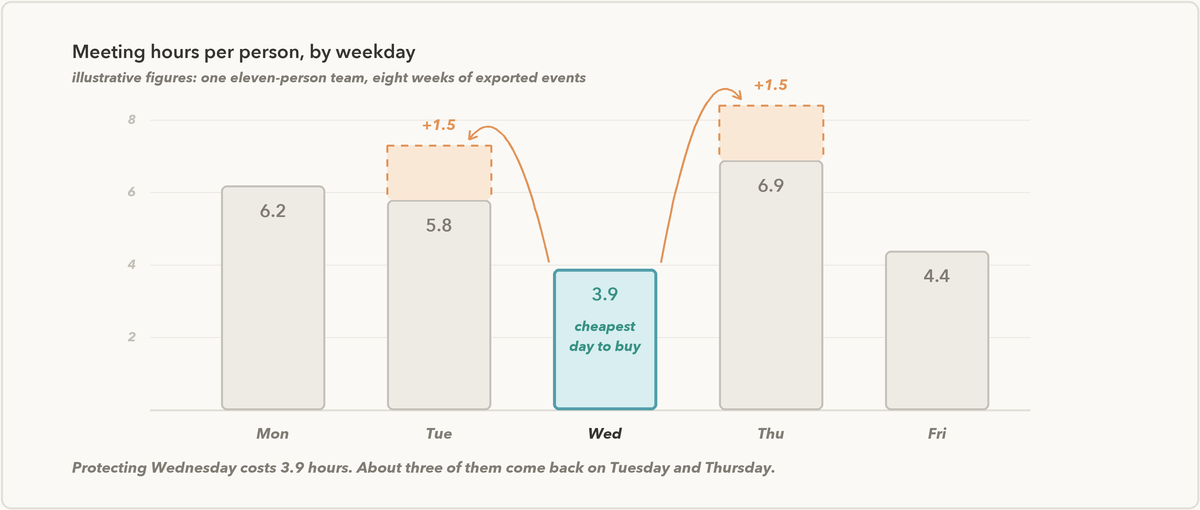
1. Measure the baseline before you announce anything (60 to 90 minutes, week 0). Export the last eight weeks of the team's calendars and compute meeting hours per person per weekday. You need two facts: which weekday already carries the lightest load, and how many hours per week are at stake. Made-up numbers, to show the shape of the answer: an eleven-person team comes out at Monday 6.2, Tuesday 5.8, Wednesday 3.9, Thursday 6.9, Friday 4.4. On that distribution the choice is Wednesday, because it is the cheapest day to buy, not because Wednesday sounds right. Your own export will not look like this one, and finding out how it differs is the entire reason to run the step.
2. Write the exception process before you name the day (30 minutes, week 0). One page: who approves, what has to be written, where the log lives, and what does not qualify. If you announce the day first and work out exceptions later, the first exception sets the precedent, and that precedent will be "ask forgiveness."
3. Bind a senior sponsor publicly (one 30-minute conversation, week 1). Not an endorsement, a binding. The sponsor states in writing that their own Wednesday meetings go through the same approval as everyone else's, and that they will report their own exception count at the six-week review. Choose the person most likely to break it, not the one most enthusiastic about it.
4. Keep the log visible (2 minutes per exception, weeks 1 to 6). A shared doc or channel with five columns: date, organizer, attendee count, one-sentence reason, and hours consumed, calculated as duration times attendees. The last column does the work. "A quick 30-minute sync" reads as small. "3.5 hours" does not, and it is the same event.
5. Give the day a job (2 minutes each Monday). A meeting-free day with no designated use degrades into an admin day, and an admin day is easy to hand back. Each person writes one line on Monday naming what Wednesday is for.
6. Review with real data at week 6 (45 minutes). Three numbers. Exception count and total exception hours. Meeting hours per person on the other four days against the baseline, which is your honest displacement figure. And what actually shipped. Then choose one of three outcomes: keep it, downgrade to a protected block, or stop. The third has to be genuinely available or the review is theater and everyone will know.
What it costs
Meeting-free days are not free, and pretending otherwise is how you lose the room at week three.
The load moves, it does not vanish. Whatever Wednesday was carrying mostly reappears on the days on either side of it, which is why step 6 measures the other four days rather than taking the win on Wednesday. What you bought is contiguity, not volume, and that is worth buying. Say so in the announcement anyway. If the first person to notice a brutal Thursday discovers it on their own, they will reasonably conclude the policy is a bad trade.
Distributed teams pay the most. A team split across San Francisco, London and Singapore may have a two-hour daily overlap window. Removing a weekday removes twenty percent of an already scarce resource, and the meetings that get displaced are exactly the ones that were hardest to schedule in the first place. Those teams should protect a block outside the overlap window and skip the day entirely.
There is also a category of work the day has to let through, and being honest about it up front is what keeps the rest defensible. Some decisions really do degrade overnight. The escalation bar for those should be reversibility and an external clock rather than importance, because "important" describes nearly every meeting anyone schedules and "irreversible after Thursday" describes very few.
Watch for the day that turns into a Slack day. If Wednesday fills with continuous chat and threads that need answering within the hour, you have built a meeting with a longer duration and no end time. Check for it at week six, using the same question you use on everything else: did anything ship.
Frequently asked questions
Which day should we pick? The one that already carries the lightest meeting load, measured, not guessed. Converting a four-hour day to zero means relocating four hours. Converting a seven-hour day means relocating seven, all of which land elsewhere in the same week, and that displacement generates the exceptions that kill the policy. You are closing a small gap, not performing a rescue. If two days tie, break toward the middle of the week: Monday collects planning and kickoff meetings that are genuinely time-sensitive, and if Friday came back light in the export, protecting it formally buys little while still costing you a rule to enforce.
What about customer calls, interviews, and other external meetings? Carve them out in the written policy on day one, by category rather than by request. Commitments you do not control, such as customer calls, candidate interviews, and vendor deadlines, sit outside the scope rather than inside the exception process. That stays clean as long as it is written in advance and named narrowly. It turns into a loophole the moment "external" starts to include an internal meeting with a partner team.
We are a 40-person company. Is this overkill? The erosion mechanism is identical at forty people and moves faster, because the seniority gradient is steeper when there are only three layers. Skip the company-wide announcement. Run it on the two or three teams whose work has the largest unit size, keep the log, and let it spread by evidence. At your size the six-week review is the whole value.
What if leadership will not commit? Then do not announce a policy, because an unenforced one costs you credibility you will want later. Run a protected block instead. Blocks are defensible by individuals without institutional backing: a recurring 9:00 to 12:00 focus event, held consistently, protects most of what a company-wide day would have protected for you personally. That is the individual-level version of this work, covered in the art of un-scheduling. Come back to policy when you have six weeks of block data to show a sponsor.
Does async replace what we lose? Partly, and less than advocates claim. Async fully replaces status exchange and information broadcast, where most of the recoverable time sits. It replaces genuine decision-making poorly, and it is worse than a meeting for anything with unresolved disagreement, because a written argument between two people can consume a week. Run a recurring meeting audit and move the substitutable meetings async before you announce the day. A meeting-free day imposed on an unaudited calendar just compresses the same meetings into four days.
Closing thought
The test of a meeting-free day is not the first Wednesday. It is the first Wednesday that costs someone senior something real, and whether that cost gets paid in public.
The only step you need this week is the first one: pull eight weeks of calendar data and find out which day is already cheapest to protect. That works in any calendar app that exports events, and it fits in an hour. Keep the log and the Monday "what is this day for" lines in whatever notes tool you already use.
What changes when notes live next to the calendar is small and compounding: the exception log sits beside the week it describes, so at the six-week review the evidence is already in front of you rather than in a document somebody has to go find. If you are running this across an org rather than one team, that pairing is what nocal's leaders page is built around: a space that holds a project's meetings, notes and tasks on one surface.
 Download for Mac
 Download for Windows
 Google Play Store