One-on-one amnesia: what every 1:1 should leave behind
Most 1:1s produce nothing durable, so the same topics resurface every few weeks and review season turns into a Slack archaeology project. Here are the four things a one-on-one should leave behind, and a 3/2/1 protocol for keeping one running note per report.
It is the Thursday before calibration and you are writing a performance review for someone you have met with, one on one, twenty-four times in the last six months.
You have the promo packet template open in one window. In the other you are scrolling Slack, filtered to your DM history, trying to reconstruct what this person actually did in March. You find a thread where they unblocked the billing migration over a weekend. You are fairly sure there was something bigger around the end of Q1. You cannot find it. You write "consistently reliable" instead, which is the sentence managers write when the evidence has evaporated.
Twenty-four conversations. Twelve hours of undivided attention. Zero retrievable record.
This is one-on-one amnesia, and it is not a memory problem. It is a storage problem.
Why one-on-ones fail to compound
Every other recurring work surface accumulates: a codebase has commits, a project has a doc that grows, a queue has tickets. The one-on-one is the highest-stakes meeting most managers run and usually the only one that writes nothing to disk.
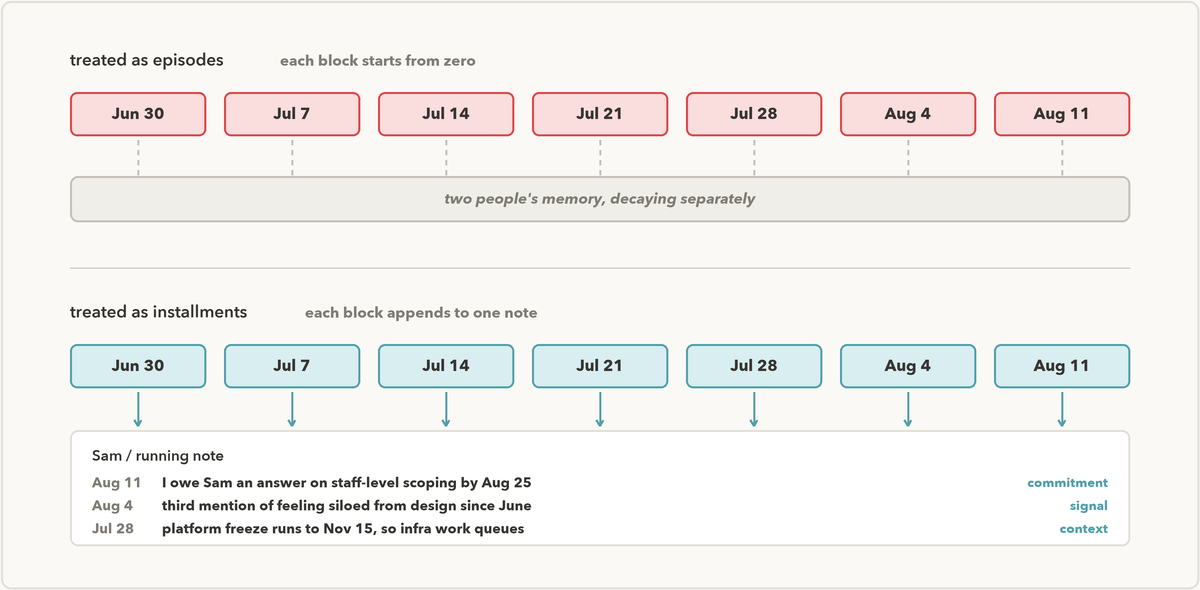
Each installment gets treated as an episode. An episode is self-contained: you show up, you talk, it resolves, the next one starts fresh. An installment continues something. The calendar reinforces the episode framing, rendering a recurring event as forty identical thirty-minute blocks with nothing to suggest that block eleven continues block ten.
Without a persistent surface, the meeting's only storage medium is two people's memory. Memory decays, which Hermann Ebbinghaus demonstrated in the 1880s and every manager rediscovers each October. Worse, two memories decay differently. Six weeks after a conversation about scope, you remember agreeing the report would push back on the design review. They remember you saying you would handle it. Neither is lying. You are both reading a corrupted copy with no original to check against.
The agenda is the second casualty. If nothing carried over, it gets rebuilt from scratch every time, under time pressure, in the first ninety seconds. Rebuilding is expensive, so the slot defaults to the one topic requiring no preparation: status. That is the least valuable possible use of a private thirty minutes, because status is already legible from the tracker, the standup, and the pull request queue.
The inertia behind calendar debt is doing the same work here, with one difference. Most decayed recurring meetings deserve to be cut. This one deserves to be given a memory.
The four things a one-on-one can leave behind
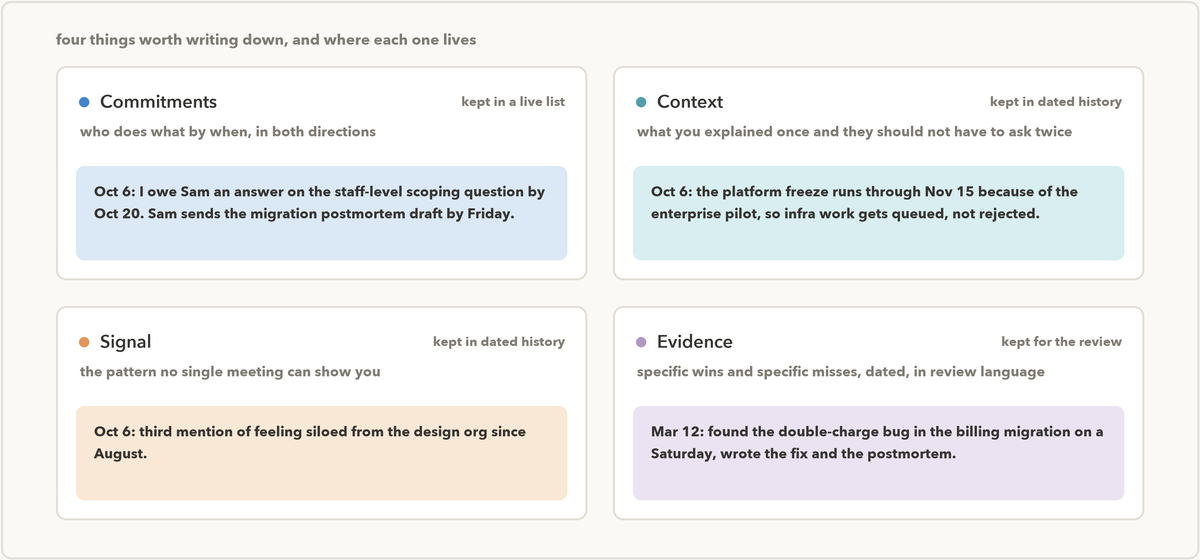
Not every sentence in a 1:1 deserves to be written down; the failure mode of note-taking managers is transcription. Four categories are worth capturing, and they behave differently enough to name.
Commitments. Who does what by when, in both directions. Most managers think they capture this and most do not, because the commitments that go missing are the ones flowing upward: "I will find out whether the headcount is approved before the end of the month." Written down, a commitment has three parts and no ambiguity: owner, action, date. Aug 11: I owe Sam an answer on the staff-level scoping question by Aug 25. Sam sends the migration postmortem draft by Friday. Two lines, both checkable at the next meeting.
Context. What you said that they should not have to ask about twice: why the roadmap reordered, what the constraint actually is, why the answer to the thing they want is "not yet" rather than "no." Managers under-record this because it felt obvious when they said it. It was privileged information delivered verbally, once, to one person now expected to make a dozen judgment calls from it. Aug 11: explained that the platform freeze runs through Nov 15 because of the enterprise pilot, so infra work gets queued, not rejected. When the question resurfaces in December you paste the line, rather than reconstructing the reasoning and accidentally reconstructing it differently.
Signal. Patterns invisible in any single meeting and obvious across ten. What keeps coming up, what stopped, what changed in tone. A report who mentions the on-call rotation once has a complaint. A report who has mentioned it in four of the last six 1:1s is a retention risk, and you cannot tell the two apart unless the six sit on one page. Signal gets written as a dated observation, not an event. Aug 11: third mention of feeling siloed from the design org since June.
Evidence. Specific accomplishments and specific misses, dated, in the form you will need them on the Thursday before calibration. Evidence is not "did well on the migration." Evidence is Mar 12: found the double-charge bug in the billing migration on a Saturday, wrote the fix and the postmortem, prevented a customer-visible incident during the pilot. One line written in March, while you still knew the details, beats four hours of archaeology in October. Write the misses at the same specificity, on the same day. A review that surprises someone is a failure of the notes as much as of the conversation.
One running note per person, not one note per meeting
The instinct, once you decide to take notes, is a note per meeting. Resist it. Forty notes titled "1:1 with Sam" give you a folder you will never open twice. Keep one note per report instead: append to it, newest entry at the top, each entry dated, each meeting adding maybe eight lines.
The format matters for two reasons. First, patterns only become visible when entries are adjacent. Four mentions of the on-call rotation across four files are four isolated remarks. In one document they are a paragraph you take in at a glance. The running note does for a person what a weekly note does for a week: it puts things next to each other so the relationships come free.
Second, prep gets cheap. It becomes a sixty-second scroll: read the last two entries, check unresolved commitments, notice anything raised more than twice. Because it costs a minute rather than fifteen, you will actually do it.
Two standing sections sit above the dated entries: open commitments (a live list, edited in place, items deleted when done) and for the review (evidence, accumulating all cycle, never edited). Everything below is append-only history.
The 3/2/1 protocol
Three minutes before. Two minutes after. One re-read per quarter. The step in the middle, during the meeting itself, is mostly a rule about what not to do. For a weekly 1:1 the whole thing runs about twenty minutes a month per report, plus a quarter of an hour at the end of the cycle.
Three minutes before. Open the running note. Read the last two entries. Check the open-commitments list and mark anything that landed. Write today's date at the top with two or three bullets under it: what you want to raise, what is unresolved from last time. Those bullets are the agenda, and they are why the slot stops defaulting to status. You arrive with a written starting point that already excludes everything you could have looked up.
During the meeting, capture decisions and commitments only. Do not transcribe. Transcription splits your attention, the person across from you can tell, and it changes what they are willing to say. Write when something resolves: a decision, a commitment, or context they will need again. Everything else stays in the conversation. In a thirty-minute 1:1 that is three to six short lines typed in the gaps, and it is fine to say "hold on, writing that down." That signals you intend to be held to it.
Two minutes after. Do not defer it to the end of the day. Clean the lines you typed into sentences that will still parse in six months. Add what you noticed but did not write: a pattern, a tone shift, something they did well. Move new commitments to the standing list and review-worthy items to the evidence section, dated. If notes live next to the calendar, this fits inside the recovery buffer you should already leave after meetings, with the block that just ended as the anchor.
One re-read per quarter. Fifteen minutes per person, end to end, and this is where signal pays. A quarter of entries read in one sitting surfaces what no single meeting can: the topic they raised in five consecutive 1:1s that you deflected five times, the growth area you flagged in April and never mentioned again. Write a short dated summary at the top when you finish, with the two or three things you are changing as a result. That entry is what your next review draft gets built from, and it is the decision log instinct applied to a person rather than a project: a dated record of what you concluded and why, kept because you will not trust your memory of it later.

The part where you decide whether to share it
A detailed, dated, private file about an employee who has never seen it is a personnel file, not a working document. Keep one secret and you have built something with a function other than the one you intended, and your report will experience it that way if they ever learn it exists. So the default is shared. Commitments and context go without exception. A commitment list only works if both parties can see it, and its better property is that it makes your commitments visible and overdue-able by the person you made them to.
Evidence should be shared too, and sharing it changes the review. A report who watches the evidence accumulate all cycle is never surprised in the review meeting, and they will add things you missed. The usual objection is that a visible list gets gamed. You have inverted that: you have told someone exactly which work gets remembered, which is a thing managers are supposed to do.
Signal is the category requiring judgment. Some of it should be shared, and saying "you have raised the on-call rotation four times and I have done nothing about it" out loud is usually the best conversation you will have that quarter. Some of it is a half-formed impression that would land as a verdict once written in a document with your name on it. The rule: shared signal must be phrased as something you would say to their face, in those words. Anything else does not belong in a file.
The usual landing spot is a note both people edit, with the report adding agenda items between meetings. That gives them somewhere to put the thing they thought of on Tuesday that would otherwise be gone by Thursday.
Frequently asked questions
Should the note be shared with my report? Yes for commitments, context, and evidence; signal takes judgment. One test covers it: if your report read the whole document tomorrow, would anything in it damage the relationship? If so, fix the sentence or have the conversation instead.
What about skip-levels? Same structure, one note per person, but the categories weight differently. Skip-levels run light on commitments and heavy on signal, because their value is almost entirely pattern detection across the org. The re-read matters more here, not less: at a quarterly cadence you get four data points a year, and by the fourth you will not reliably remember the first. Never write anything in a skip-level note that reads as a report on their manager.
Is this not just micromanagement with extra paperwork? It reduces the need to ask for status, which is the actual mechanism of micromanagement. A manager holding a written record of what was agreed does not check in on Wednesday, because the commitment has a date and the date has not arrived. Managers who ask for constant updates are usually the ones with no durable record, polling anxiously against their own memory. Writing things down is what lets you stop asking.
What if my report brings nothing to discuss? That is itself a signal, usually one of three: the meeting has trained them it is a status review, so they bring status; they do not know what the slot is for; or something is wrong and they have decided this is not where it gets raised. The running note fixes the first two, because two written bullets from last time change the opening question from "so, anything for me?" to "last time you mentioned the design review, where did that land?" For the third, the quarterly re-read is your detection mechanism. Six consecutive entries of pure logistics is telling you something.
Closing thought
The measure of a one-on-one is not how the thirty minutes felt. It is whether the eleventh one knew what happened in the tenth.
To try it, start with one person and one file, in whatever notes app is already open. Title it with their name, put today's date at the top, and write the three things you owe each other. Read it before the next meeting. That loop is most of the value and you can run it this week.
What changes when the note lives next to the calendar is friction on the two-minute pass, the step everyone skips. In nocal, a Space keeps a person's running note, their meetings, and the open tasks from those meetings on one surface, and a note can be linked to the event, so the block that just ended opens the file you need to update. That is a convenience. The method survives without it: one note per person, appended to, read before you walk in. More on how managers work this way.
 Download for Mac
 Download for Windows
 Google Play Store