The status meeting is a reporting failure, not a coordination tool
Status meetings survive because reading is unenforceable while attendance is observable, and because speaking costs the speaker less than writing. Here is what is actually inside one, why cancelling it usually backfires, and a two-week routing audit that shrinks it to the part that deserves to be live.
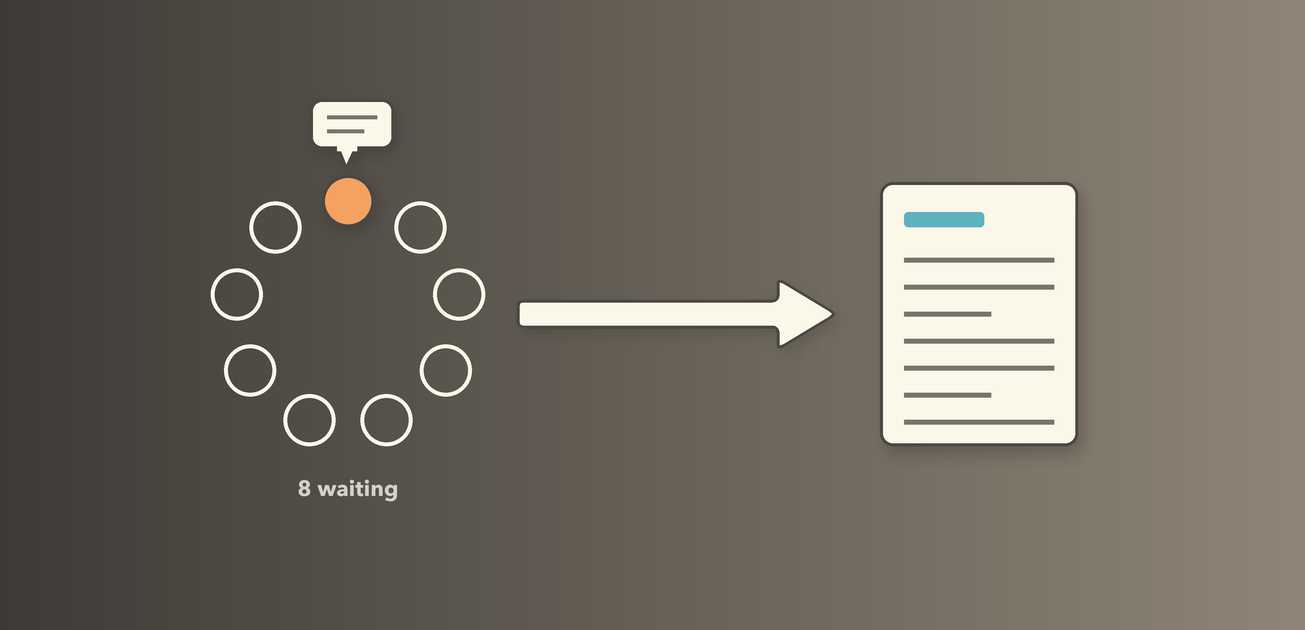
It is 10:00 on Thursday and there are nine people on the call. The format is a round: four minutes each, what you finished last week and what you are starting this week.
You are seventh. For twenty-four minutes you are not in a meeting, you are in a queue. An engineer walks through a migration whose pull request you reviewed on Tuesday. Someone reads out a number already sitting on a dashboard two people have open in another tab. When your turn comes you say four sentences, two of which you posted in a channel on Monday. Nobody asks a follow-up.
At 10:47 it ends. One genuinely useful thing happened. At minute thirty-one, someone mentioned the pricing page was stuck waiting on legal, and the person who could unstick it was in the room and said "I will take that." It lasted about forty seconds.
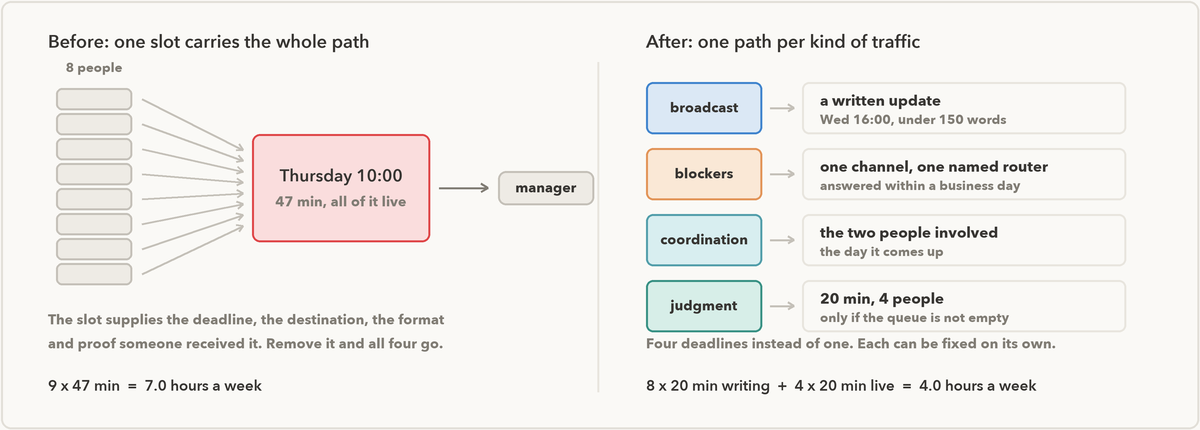
Nine people, forty-seven minutes, close to seven hours of salaried attention, for forty seconds of routing and one manager's quiet relief that everything sounded fine.
What a reporting path has to supply
Take the room away and what is left is a reporting path. Any reporting path needs four things to function. A destination everyone knows to check. A deadline, because an update with no due date does not get written. A format short and consistent enough that reading it is cheaper than asking. And some proof that it landed, so the person who needs to know can stop wondering.
Now look at what the Thursday slot supplies. The recurring event is the deadline. The room is the destination. The round is the format. Nine faces on a call is the proof. One calendar entry provides all four at once, built out of the only resource a team can reliably get its hands on: everybody, simultaneously, on the clock.
That is the mechanism, and it explains why these meetings are so hard to kill. Cancelling one takes away four things at the same time. Move status into a document and leave the deadline behind, and updates arrive for two weeks, then Tuesday's is late, then two people quietly stop. Leave the proof behind and the manager starts asking people individually, which costs more than the meeting did. Leave out a route for the stuck items and a blocker that used to wait until Thursday now waits until somebody happens to remember it.
So the meeting is a symptom. Something in the written path is missing, and the calendar is where teams go to buy a replacement at retail price: live human attention, purchased in parallel, from people who are mostly not the audience for the item being read.
That gives a testable prediction. Supply those four properties in writing and most of the meeting deletes itself. Whatever survives was never status. It was judgment in a status costume.
Why a meeting nobody defends keeps its slot
Almost nobody defends this meeting on the merits. It survives anyway, and not because people are irrational. Three forces hold it in place, and each has to be handled separately or it grows back.
Reading is unenforceable. Attendance is observable. You cannot tell who read a written update. A meeting converts an unobservable act into an observable one, and it does something stronger besides: everyone in the room watches everyone else receive the same thing at the same moment. The political scientist Michael Chwe calls that common knowledge in Rational Ritual, his book on why groups coordinate around public events rather than private messages. A public event does more than reach each person. It lets each person know what the others now know. A round manufactures that in forty-seven minutes, and eight separate reads of the same document never produce it. So a manager under pressure to guarantee that information landed will pick the mechanism that produces evidence, and "just send it in writing" fails as advice because it asks someone to trade a verifiable process for an unverifiable one.
Speaking is cheap for the speaker and expensive for everyone else. A good written update costs the writer twenty to thirty minutes: deciding what matters and making it legible to someone who was not there. Saying it out loud costs four minutes and no preparation, because the listeners do the assembly in real time. The individual move is rational and the arithmetic is backwards. One writer's thirty minutes gets replaced by eight listeners' four minutes each, plus the damage the meeting does to the day around it, which rarely gets booked anywhere. Cost moves from the person best positioned to compress the information to the people worst positioned to filter it.
The meeting is doing a second job that nobody wrote down. This is what most arguments about status meetings miss, and it is why well-reasoned cancellations quietly reverse six weeks later.
Few recurring meetings do only the thing on the agenda. The status round is usually also one of these: reassurance for a manager with no other reliable signal that the work is on track; visibility for people whose contribution is otherwise invisible upward; social contact for a distributed team with no other scheduled reason to be in one room; or soft accountability, where saying "still working on it" out loud for the third week running does something a status field in a tracker does not.
None of those are illegitimate. A manager who needs reassurance is not weak, they are missing an instrument. An engineer making sure their director knows the migration was hard is responding to a real career problem.
And none of them are served by writing. Move the information into a document, cancel the meeting, and the information problem is solved while the second job is orphaned. Six weeks later someone proposes a "quick weekly sync to stay connected," which is the same meeting with a friendlier name.
So the honest advice is not "kill the status meeting." It is: find the second job, name it, and give it a home before you touch the calendar.
What is actually inside a status meeting
Four kinds of traffic move through a status round. They sound alike because they arrive in the same voice in the same slot, and they have completely different correct destinations.
Broadcast. One-to-many, no response expected. "The migration finished Tuesday." "Q3 came in at 94 percent of target." "I am out Thursday and Friday." Broadcast is reliably the largest of the four categories by minutes. Your own log will give you the exact share, and it is usually more than half. All of it belongs in writing, where it is scannable, skippable and searchable later. Reading it aloud to eight people, six of whom do not need it, is the most expensive way to move it.
Blockers. Something is stuck and needs a decision or a specific person. These do not belong in the meeting either, but for the opposite reason: it is too slow, not too expensive. A blocker that surfaces Thursday morning and started Monday afternoon cost three days of a stalled workstream. One that waits for the weekly slot is evidence that the routing path does not exist or is not trusted.
Coordination. Two people, sometimes three, need to align on a handoff. "If your API change lands Wednesday I need to update the client before Friday." That should happen between the two of them, for the eleven minutes it needs, not in front of seven observers waiting for it to end. The round is where coordination gets discovered, which feels like value, but the value is in the discovery rather than the venue.
Judgment. Something is genuinely uncertain and reasonable people disagree. Cut scope or slip the date? Is the complaint a pattern or an outlier? Keep the vendor another quarter? This needs disagreement, reaction, and the ability to change position out loud, so it needs people in one room at one time. In the round at the top of this post it took forty seconds. Eight minutes out of forty-five would be a strong week.
The routing audit
You probably cannot cancel this meeting, and cancelling it cold would fail anyway. This runs from inside the meeting you already attend.
Weeks 1 and 2: instrument, do not argue (0 extra minutes). Keep a note open during the meeting; you are already sitting there. For every item write one line: who raised it, five words on what it was, the category, and a rough duration. Do not announce it, and do not change your own behavior. Every previous attempt to fix this meeting was a debate between opinions. This one is a debate about a document.
End of week 2: tally (20 minutes). Add up minutes by category and write four numbers. In a healthy meeting judgment is the largest. In an unhealthy one the order runs broadcast, coordination, blockers, judgment, with broadcast alone over half. Then answer one question honestly: what would have gone wrong if the broadcast items had been read instead of spoken?
Week 3, day 1: move broadcast to writing, with a spec (30 minutes). "Post updates" fails every time. Write the spec in six lines: where it goes, who posts, by when, maximum length, required sections. Something like: the team channel, by 16:00 Wednesday, under 150 words, three sections (shipped, in progress, needs attention). The deadline matters more than the format, because forcing a deadline onto reporting was one of the four things the slot was doing. Remove the meeting without replacing the deadline and the reporting stops inside a month.
Week 3, day 1: open a blocker path and name the router (10 minutes). One channel, one named person who routes anything posted there within a business day, and an explicit rule that a blocker never waits for Thursday. Blockers wait because nobody is sure whose problem they are.
Week 3, day 2: hand the coordination pairs back (15 minutes). Each coordination item in your log names two or three people. Message them directly: "you two coordinated the client update inside the status round twice, so do it directly and skip the audience." This usually recovers the most time, because coordination items are the longest lines in the log.
Week 3, day 3: shrink the meeting to judgment (15 minutes). Cut the length to your judgment number plus half again, with a floor of 20 minutes so a light fortnight does not shrink the slot below anything useful. Cut the attendee list to people with a stake in the open questions. Change the agenda from a round to a queue: items go on a shared list in advance, and if the list is empty on the morning of, that week is cancelled. The empty-agenda rule is what stops the round growing back, because a round is what fills an agenda with nothing in it. It is the decomposition move from the calendar debt audit, applied to one meeting.
Week 3, day 3: give the second job a home (10 minutes). Do this in the same conversation, not later. Reassurance needs an instrument: a mandatory "needs attention" section works, but say out loud that it exists so you do not have to ask. Visibility needs the updates routed upward and not only across, because writing is forwardable and speech evaporates. Social contact needs its own slot, honestly labeled and genuinely optional. Accountability needs each commitment written as a date and reviewed as a date.
Run four weeks, then log again. Teams typically land at 20 to 25 minutes with four to six people. Whether you are one of the managers running a team or one of the leaders running a function, start with the meetings you own: those are the most likely to be carrying a second job for you.
When a status meeting is actually correct
A new team with no shared context. For six to ten weeks the round builds a model writing cannot: who does what, how people talk, what "on track" sounds like here. The redundancy is the point. Revisit at week ten.
A crisis or an active incident. When the situation changes hourly, a written update is stale before it is read. Frequent synchronous sync is right during an incident and wrong two weeks after it ends, which is exactly when it becomes permanent.
Low-trust or low-writing environments. If your organization treats a document as something you present rather than something you consume, a written reporting system will fail and the failure will be blamed on you. Fix the writing culture in a smaller blast radius first.
Teams where updates genuinely go unread and the cost is high. If an unread update produces a missed dependency that costs a week, the meeting is cheaper than the failure. Run that calculation with the number from your log.
Frequently asked questions
My leadership requires this meeting. Do not open with cancellation. Open with the log: two weeks of data, and a proposal that keeps the slot but changes what happens inside it. Offer the written update as an addition first, run both for three weeks, then observe that the meeting is now reading a document aloud. Leadership rarely requires the round. They require the assurance it was providing.
My team will not read written updates. Sometimes true, and worth taking seriously rather than treating as a discipline problem. Three causes account for most of it: the updates are too long, they arrive with no deadline, or nothing ever happens as a result of reading them. Fix length and deadline first. If it still fails, keep the meeting and open it with silent reading in the room. Amazon has done this for years: no slide decks, six-page narratively structured memos instead, read silently at the start of the meeting in what Jeff Bezos described in the 2017 shareholder letter as a kind of study hall. A 150-word update needs about two minutes of that, not twenty. It looks strange and it works, because it makes reading observable, which is the exact property the status round was providing.
Does this apply to standups? Standups fail the same way and need a different fix. The failure is identical: a round where each person reports to a manager while their peers wait. But a daily 15-minute standup has no room for a queued agenda, and its coordination content is legitimately higher because the horizon is one day rather than one week. The fix is narrower: change the unit from people to work. Walk the board, not the room, and let anyone with nothing to add say nothing.
We are remote and this meeting is our only social contact. Then that is the dominant second job, and no, do not delete it. Stop paying for social contact with an information format nobody wants. Separate them: a 20-minute judgment meeting with the people who need it, and an optional slot whose stated purpose is that people want to see each other. Both get better once neither is pretending to be the other.
Closing thought
The best evidence that a status meeting was never a coordination tool is what happens once the reporting works. It does not shrink until it disappears. It shrinks until it hits a floor made of the questions nobody could answer alone.
That floor is the meeting you actually wanted. It was in there the whole time, at minute thirty-one, taking forty seconds.
Try the first step this week. Open a note during the next status meeting and log every item with a category and a rough duration. Change nothing else, and in two sessions you will have the argument in numbers. This works in any tool where you can keep a note open while a meeting runs, and if that note lives attached to the event itself, next week's log lands beside this week's without you filing anything.
Related posts
- One-on-one amnesia: what every 1:1 should leave behind
- Meeting-free days are a policy, not a preference: why No-Meeting Wednesday erodes in three weeks
- Calendar debt: the quiet tax your recurring meetings are charging your team
- Notes an agent can read: the resolution gap between what you wrote and what you meant
 Download for Mac
 Download for Windows
 Google Play Store