MCP is about to change what second brain apps can do
The Model Context Protocol gives AI agents persistent access to your notes, calendar, and knowledge base. Here is why that changes everything for productivity software.
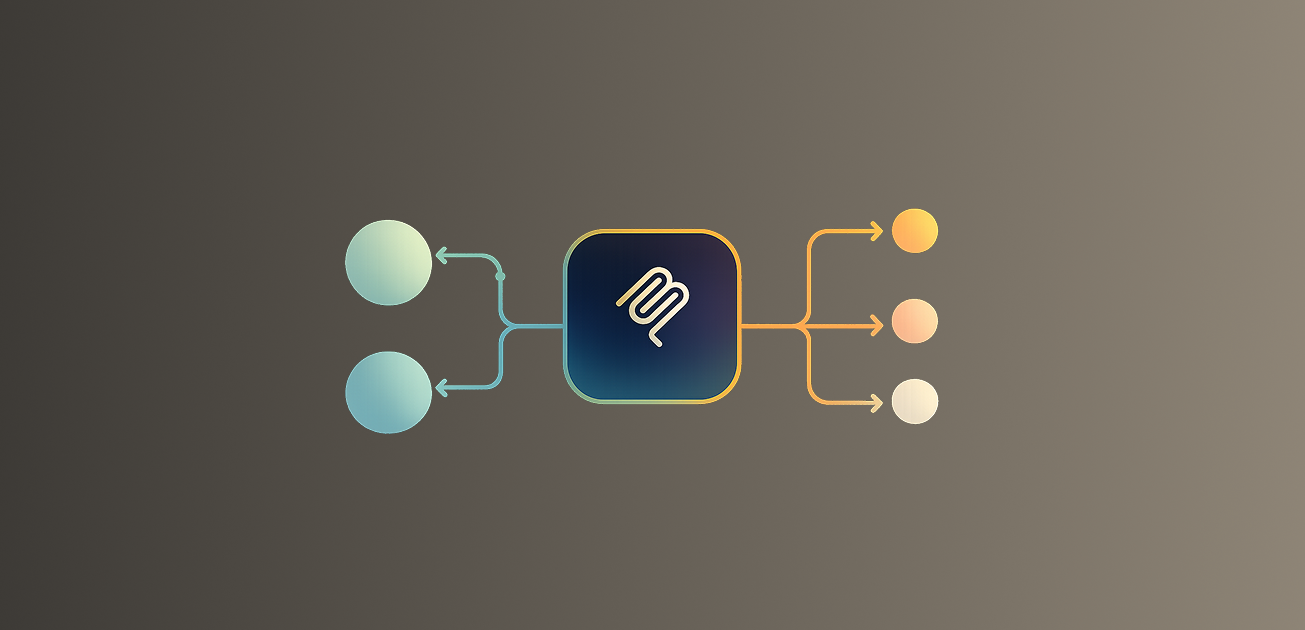
For years, the promise of a "second brain" was that you could build a personal knowledge base: capture everything, organize it well, and retrieve what you need when you need it. Tools like Notion, Obsidian, Roam, and dozens of others helped people get there.
The problem was always the last mile: retrieval. You still had to know what to search for. You still had to remember where you put something. The second brain was only as good as your ability to query it manually.
MCP changes that.
What MCP Actually Is
Model Context Protocol (MCP) is an open standard, introduced by Anthropic in 2024, that lets AI models connect to external tools and data sources through a common interface. Before MCP, integrating an AI assistant with a specific app required custom API work on both sides: slow, expensive, and fragile. MCP standardizes the connection layer.
The practical result: AI tools like Claude, ChatGPT, Cursor, and others can now connect to apps that expose an MCP server and interact with them directly, reading data, writing updates, and taking actions, all from within a single conversation or agentic workflow.
For productivity software, this is significant. It is not a chatbot feature. It is infrastructure.
The Second Brain Problem MCP Solves
Most knowledge workers today operate with a gap between two systems that should be connected:
System 1: Where you think and plan. Notes, calendar, project docs, meeting records, weekly reviews. This is your second brain: the accumulated context of how you work.
System 2: Where AI helps you act. Coding assistants, writing tools, research agents, scheduling bots. These operate on the immediate task but rarely on your broader context.
The gap between these systems is where leverage gets lost. You ask an AI to help you prepare for a meeting and have to paste in notes from somewhere else. You ask for help drafting a project update and have to summarize the background yourself. You ask for a list of open commitments and spend ten minutes manually compiling it.
MCP gives AI agents a direct connection to System 1. That changes the quality of what they can do.
What Becomes Possible
Agents that know your history
When an AI has access to your notes and calendar through MCP, it can answer questions like:
- "What did we decide about the pricing model in our last three meetings with this client?"
- "What action items from last quarter are still open?"
- "Who have I been meaning to follow up with?"
These are not trivial questions to answer manually. With MCP, they become routine queries.
Automatic context enrichment
Agentic tools can populate your knowledge base without you doing it manually. An agent that drafts a research summary can write it directly into your notes. An agent that extracts action items from a transcript can log them where you track commitments. The flow of information into your second brain becomes continuous rather than periodic.
Cross-app coherence
Your calendar is not separate from your notes. Your project context is not separate from your schedule. MCP-connected apps can treat these as a unified knowledge graph rather than isolated data stores. An agent can pull from your calendar to understand your schedule constraints, check your notes to understand your priorities, and give advice that reflects your actual situation.
True personal AI
Today, AI assistants are mostly stateless. Each conversation starts fresh. MCP-connected second brain apps break that pattern. When your notes and calendar are accessible, the AI has durable context: it knows what you have been working on, what you care about, what is coming up. That is the foundation for AI assistance that actually feels personal rather than generic.
Why This Matters for Second Brain Apps Specifically
Not all app categories benefit equally from MCP. Second brain apps, meaning apps that store your personal knowledge, plans, and context, are uniquely well-positioned.
The reason: value of AI assistance scales with the quality of context it has access to. A well-maintained second brain contains the most valuable context a knowledge worker generates: decisions, commitments, meeting history, project thinking, planning artifacts. When AI agents can read and write that context, the ROI on both the second brain and the AI assistant increases significantly.
Conversely, second brain apps that do not expose MCP interfaces will increasingly function as silos. The information in them becomes less useful as agentic workflows get built around connected alternatives.
The Likely Trajectory
MCP is early. Tooling is still developing, agent capabilities are still maturing, and most users have not yet connected their knowledge apps to their AI tools. But the direction is clear.
Over the next 12 to 24 months, expect:
- More apps shipping MCP servers. The standard is gaining adoption quickly. Calendar apps, note apps, task managers, and CRMs are all obvious candidates.
- Agents that operate across multiple MCP sources. An agent that can pull from your notes, your calendar, and your email will be qualitatively more useful than one that works in isolation.
- Workflows that were manually intensive becoming fully automated. Weekly reviews, project status updates, follow-up tracking, commitment management: tasks that currently require manual synthesis across multiple tools.
- A widening gap between MCP-connected and disconnected apps. Apps that sit inside the agentic layer will compound in value. Apps that sit outside it will stagnate.
The second brain use case is not going away. The knowledge you capture, the plans you make, the meetings you attend: all of it will always need a home. What is changing is what becomes possible when that home is connected.
FAQ
What is MCP? Model Context Protocol is an open standard created by Anthropic that allows AI models to connect to external data sources and tools through a common interface. It standardizes how AI assistants integrate with apps like calendars, note tools, and databases.
Why does MCP matter for productivity apps? Productivity apps store your context: notes, calendar events, project history. MCP lets AI agents access that context directly, enabling assistance that reflects your actual situation rather than just the information you paste into a chat window.
What kinds of tasks can MCP-connected AI handle? Common use cases include extracting action items from meeting notes, summarizing project history, finding open commitments, drafting context-rich updates, and logging research or outputs directly into your knowledge base.
Is MCP widely supported? Major AI clients including Claude, ChatGPT, Cursor, and VS Code support MCP. Adoption among productivity apps is growing. The standard is actively maintained and expanding.
What makes second brain apps a good fit for MCP? Second brain apps store high-value, durable context: meeting history, decisions, project thinking, weekly plans. That is exactly the type of information AI agents need to give useful, personalized assistance. The fit is natural.
Related posts
- Notes an agent can read: the resolution gap between what you wrote and what you meant
- Meeting-free days are a policy, not a preference: why No-Meeting Wednesday erodes in three weeks
- How to plan a quarter in 90 minutes: pick one big rock and put it on the calendar
- The status meeting is a reporting failure, not a coordination tool
 Download for Mac
 Download for Windows
 Google Play Store